Showing posts with label Butterflies. Show all posts

Tuesday, June 23, 2026

Silver-studded Blues on the Purbeck Heaths

Male Silver-studded Blue - Scotland Heath, Dorset

Britain's resident butterflies can be divided into two main groups - the wider countryside species and the habitat specialists. You will see the first group in gardens, parks and farmland - Large White, Meadow Brown and the like. Many are very mobile, and they can turn up pretty much anywhere. Most are familiar to us. 

You have to work harder to find the second group - our habitat specialists. These are restricted to certain special places, for example where their foodplants grow, and they are less likely to travel over the wider landscape. You usually have to make an effort to find them!

The Silver-studded Blue Plebejus argus is a classic habitat specialist. In the UK it is mainly found on lowland heaths and certain parts of the English and Welsh coasts (see the distribution map on Butterfly Conservation's helpful fact sheet). But this doesn't tell the whole story. The odd fact about Silver-studded Blues is that they live in two contrasting habitats, where the plant species are very different.

We see this in Dorset, south-west England. Here, most Silver-studded Blues are found on lowland heaths in the Poole Harbour basin area, particularly in the Purbeck area south of Wareham. These heathlands are famously the home of a range of rare and often endangered species - ranging from the charismatic Sand Lizard (see my blogs here and here) to the more obscure Purbeck Mason Wasp (see my blog here).

Silver-studded Blue habitat - Scotland Heath, Purbeck, Dorset

However, you can also come across Silver-studded Blues on Dorset's Isle of Portland, where the lime-rich grassland looks very different to Purbeck's heather and gorse-dominated heathlands. There is a clear gap between the two populations, and there is little (actually, no) evidence of the butterflies moving between the two areas. So, what's going on here? To answer the question we need to look at the butterfly and its unusual ecology.

Introducing the Silver-studded Blue

Although the blue butterflies (part of the Lycaenidae family) are some of Britain's more eye-catching insects, telling the various species apart is not always straightforward - even in Britain with its relatively low butterfly diversity. Silver-studded Blue males are perhaps most easily confused with Common Blues, which are much more, well, common. As well as being smaller, the most obvious difference is that male Silver-studded Blues have a wider black margin on the wings than male Common Blues (see the photos below).

Male Silver-studded Blue - Grange Heath
For comparison: male Common Blue - Powerstock Common

At which point, you might be asking: what about the 'silver studs'? These are actually on the back of the wings, and they are not always very obvious. Look for the small bright dots in the middle of the black spots - one is arrowed in the image below: 

Male Silver-studded Blue - wing underside. 'Silver studs' arrowed.

The 'silver studs' are also present on the underside of the female's wings, which is just as well because the females - which have dark brown wings - are otherwise tricky to separate from the females of Common Blue, Brown Argus and a few others. The studs can (just about) be seen in this image of a female below (there is a better image later):

Female Silver-studded Blue - Scotland Heath

Luckily, Silver-studded Blues are not difficult to find, as long as you are in the right place. Over the last few weeks I have been carrying out wildlife surveys on the Purbeck Heaths (not for butterflies, as it happens) and Silver-studded Blues have been one of the most numerous and conspicuous insects that we have encountered. They have a characteristic flight pattern, keeping low over clumps of heather, pausing often to rest on flowers. They usually won't fly far from where you first see them; some research says that they rarely move more than 10-20 metres, although from what I've observed this may be an underestimate.  

Unusual Life Cycle

Silver-studded Blue caterpillars (larvae) have two types of foodplants, depending on their habitat. At the Dorset heaths, they feed most commonly on heathers (Calluna vulgaris and species of Erica), while on Portland's limestone grasslands it is more likely to be Bird's-foot Trefoil, Common Rock-rose or Horseshoe Vetch. So far, so different.

What links the two habitats is the relationship between the caterpillars and ants - specifically black ants. The caterpillars produce sugar-rich liquids that attract and feed the ants; in return, the ants look after the caterpillars. It seems that the ants move the caterpillars into underground chambers, from where they emerge at dusk to feed (possibly carried by the ants). Eventually, the butterfly caterpillar will pupate underground, and an adult will emerge in turn. This all seems very benign, and I can't find any evidence of more sinister behaviour taking place, such as caterpillars feeding on the ant brood, as happens with the (even rarer) Large Blue

The ant-caterpillar relationship doesn't happen by chance. Adult female Silver-studded Blues can detect chemical signals (pheromones) produced by the ants, which they will follow to find suitable a site for egg laying. On Purbeck's Grange Heath a couple of weeks ago we were lucky to find a Silver-studded Blue surrounded by black ants:

Silver-studded Blue male with black ants

Nearby, a pair of Silver-studded Blues were mating: the 'silver' studs on the female (more easily seen here) are almost blue in colour. 


Silver-studded Blues mating - male above, female below

While the association with black ants takes place in both habitats, the species of ant differs. On acid heathland it's usually Lasius niger, while on limestone grassland it will be Lasius alienus. I don't know enough about ants to distinguish them in the field, but I presume that the ones photographed above on Grange Heath were L. niger. (If they aren't, please let me know!)

Conserving Silver-studded Blues

In Britain, the combination of recent population decline and restricted distribution of Silver-studded Blues mean that they are classed as 'vulnerable' on the UK Red List, although the species is much more widely distributed in continental Europe. The good news is that even in England and Wales they are usually present in good numbers on the sites where they occur. Even better, numbers have risen dramatically on sites in Purbeck such as Studland, although the picture is less encouraging for the grassland population on Portland (Warren et al., 2025).

On heathland, conservation management aims to maintain a patchwork, or mosaic, of different ages and types of heather as well as some bare ground. Suitable grazing and/or burning can achieve this. For grassland, it is important to manage grazing levels so they do not become too excessive; creation of bare ground areas is also recommended. Such actions will benefit other heathland species too.  

Finding Silver-studded Blues

The photos of Silver-studded Blues in this blog post were all taken on the Purbeck Heaths, which is where (in my experience) the butterflies are most easily found in Dorset. While I have seen them on Portland, numbers there are lower than at Purbeck, and there is also a greater risk of confusing them with other blue butterflies. Chalk-hill Blue and the beautiful Adonis Blue are present on Portland's limestone grassland, but absent from Purbeck's acid heaths. The flight period runs from mid-June to the end of August, so now's the time to get out and look for them.  

Many of Purbeck's heathlands are accessible to the public, and most lie within the Purbeck Heaths National Nature Reserve (link here). At RSPB Arne (where I volunteer), Silver-studded Blues can be seen from the trails on Coombe and Hyde's Heaths.
 
Male Silver-studded Blue - Grange Heath


References


Asher, Jim, Warren, Martin, Fox, Richard, Harding, Paul, Jeffcoate, Gail and Jeffcoate, Stephen (2001). The Millennium Atlas of Butterflies in Britain and Ireland. Oxford: OUP.

Hetherington, Mike, Sterling, Phil and Coulthard, Emma (2022). 'Butterfly colonisation of a new chalkland road cutting.' Insect Conservation and Diversity, 15(2), pp.191-199. - link

Munns, Lorraine (2017). Is it all about the ants? What are the factors influencing the presence of Plebejus argus (the Silver-studded Blue butterfly) on Studland Peninsula? (Doctoral dissertation, Bournemouth University).

Sterling, Phil and Henwood, Barry (2020). Field guide to the caterpillars of Great Britain and Ireland. London: Bloomsbury.

Thomas, C.D. (1993). 'The silver-studded blue, Plebejus argus L.' The conservation biology of Lycaenidae (butterflies), pp.97-99. - link

Thomas, Jeremy, Surry, Richard, Shreeves, Bill and Steel, Carolyn (1998) New Atlas of Dorset Butterflies. DNHAS.

Tolman, Tom and Lewington, Richard (2008) Collins Butterfly Guide. London: HarperCollins. 

Warren, M.S., Rich, S. and Haywood, N. (2025). 'The dramatic rise of the Silver-studded Blue, Plebejus argus, over 50 years at Studland Heath National Nature Reserve, Dorset, UK' - link

Text and images (c) Mike Hetherington


Wednesday, May 22, 2024

On Moths and Butterflies


My slightly tongue-in-cheek social media post yesterday (below) provoked an entertaining exchange of views on the differences - or, more exactly, the lack of differences - between moths and butterflies. 


I chose the images deliberately to suggest the similarities between moths and butterflies. But for many people there is a deep and profound divide. "I love butterflies" versus "I hate moths". Butterflies flap colourfully around in the sun, while moths are seen as sinister creatures of the night that eat your carpets. 

This bias appears surprisingly pervasive. Butterfly Conservation does a lot of great work for moths. (I am a member, and I urge you to join too - there's a link here.) It runs the National Moth Recording Scheme, carries out moth research (check out the excellent State of Britain's Larger Moths 2021 report, which can be downloaded free from the website) and undertakes moth conservation projects. Its Atlas of Britain's and Ireland's Larger Moths is an essential resource (I sponsored a moth in it - see whether you can find it!). Through its #MothsMatter campaign, Butterfly Conservation acts as a much needed cheerleader for moths, while its officers appear regularly on the TV to explain why most moths do not actually eat carpets.

However, you only have to look at Butterfly Conservation's members' magazine to understand that moths are secondary to the interest in butterflies. The magazine is called "Butterfly", for a start. In a (very) much smaller font you will find the strapline: "Saving butterflies, moths and our environment". Butterfly Conservation's Twitter (X) handle is @savebutterflies. Several times, I have suggested to BC officers that the charity's name could be changed to include a reference to moths: the response has always been on the lines of "it's just not going to happen". 

Aside from the fact that a lot of BC members simply like butterflies (and there's nothing wrong with that), there is another (largely unstated) reason why moths aren't given equal billing. Namely, the fear that mentioning moths will put people off from joining and donating. I don't know whether this is based upon any hard evidence - it may have been focus-grouped, I suppose - but there's no denying that there is a weird, and largely irrational, dislike of moths out there. A particularly bonkers example is in a Guardian comment piece from 2012, titled "Why I Hate Moths"

(By the way, if you do open this link, you will see that the main photo, which has appeared all over the place including the Times, Daily Express and Good Housekeeping, is a classic piece of deliberate misinformation: two geometrid moths have been placed next to a hole in a woollen jumper. As most of you will know: (1) these aren't clothes moths, (2) only a tiny number of moth species damage fabric and (3) it's the larvae that do the damage, not the adult moths.)

But if the level of aggression against moths in some quarters seems disproportionate, then it's perhaps also rather odd to focus too strongly on butterflies in preference to moths. Three reasons why:

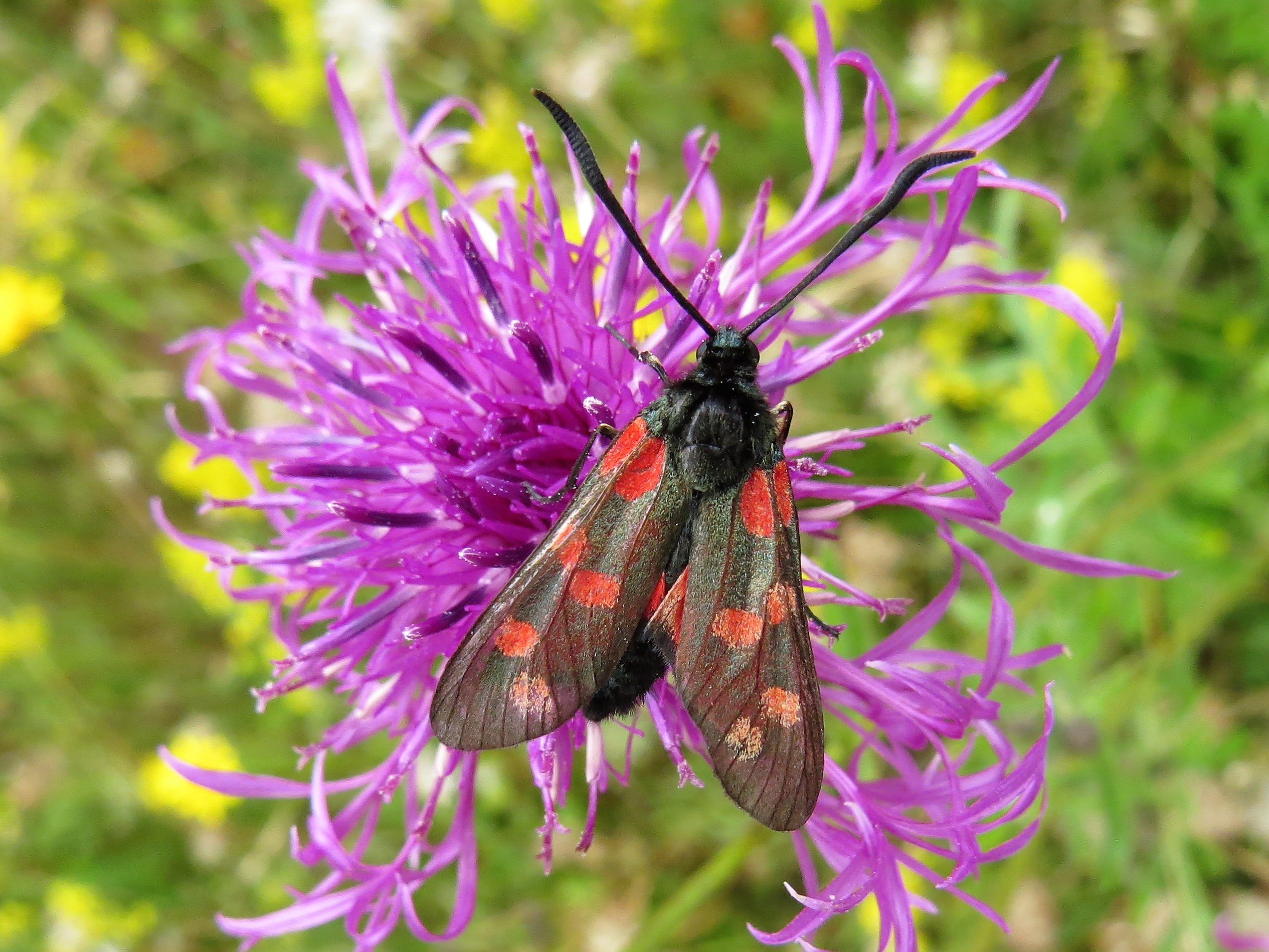
First - many moths are spectacular and conspicuous. There are at least as many day-flying moth species in Britain and Ireland as there are butterflies. Below are a couple of the more showy ones - Jersey Tiger, a species that has colonised the south of England and is heading north, and Narrow-bordered Five-spot Burnet - one of a number of burnet moths, all of which are vibrantly coloured.

Jersey Tiger - Dorset


Narrow-bordered Five-spot Burnet - Northumberland

Second - butterflies only make up a small part of the Lepidoptera (the order containing moths and butterflies). Published numbers vary, partly because new species are being added to the list regularly, but a good estimate of the total count for the Lepidoptera is around 157,000 species (Stork, 2018), of which between 15-20,000 are butterflies - around 10%. In Britain and Ireland, the difference is even more stark: we have around 60 resident butterfly species compared to around 2,500 moths - only about 2.5%. 

Butterflies are the exception; moths are the rule.

This means that, even in our biologically impoverished islands, moths demonstrate significant and interesting species diversity. There is much to learn, and many fascinating stories to tell. For example, studies of moths have pointed towards reasons for the general decline of insect numbers (see my blog post on this here). 

Third - and this is the crucial one - there is really no meaningful distinction between moths and butterflies anyway. As we have seen, moths fly during the day as well as at night. Many moths are bright and colourful. The uraniid moth from Ecuador's Yasuni National Park pictured below is perhaps an extreme example, but it makes the point. See also the Cream-spot Tiger photo at the head of this blog post.


Uraniid moth (Urania leilus) - Ecuador

Look harder at the taxonomy and you will struggle to find differences as well. Butterflies are grouped together in a 'superfamily' (the Papilionoidea), that appears to have split-off from the main 'family tree' of the Lepidoptera around 100 million years ago. A recent study has suggested that this split took place in North America (Kawahara et al., 2023). But the butterfly superfamily sits within the rest of the Lepidoptera - and these are all moths. They include families that are more 'primitive' than butterflies (for example that have a single genital opening for mating and egg-laying) as well as families that share the same characteristics as butterflies - for example two genital openings (Lees & Zilli, 2019).  The oft-quoted 'fact' that butterflies have clubbed antennae while those of moths is tapered is confused by the sheer diversity of moth forms. For example, the antennae of Burnet Moths, such as this Six-spot Burnet below, end in a wider section that then tapers. Not unlike that of a Dingy Skipper (also pictured below).


Six-spot Burnet - Dorset

 
Dingy Skipper - Dorset

As such, there is no one characteristic that separates butterflies from moths. Moths can therefore be defined as 'Lepidoptera that aren't butterflies'. But - to cut to the chase - it's far easier to say that butterflies are actually moths!

So, let's hear it for a bit of blurring of boundaries, and leaping out of traditional silos. If you love butterflies, then try dipping a toe into the magical world of moths. You won't regret it!

References

Lees, D.C. and Zilli, A. (2019) Moths: Their biology, diversity and evolution. London: Natural History Museum

Kawahara, A.Y., Storer, C., Carvalho, A.P.S., Plotkin, D.M., Condamine, F.L., Braga, M.P., Ellis, E.A., St Laurent, R.A., Li, X., Barve, V. and Cai, L. (2023). 'A global phylogeny of butterflies reveals their evolutionary history, ancestral hosts and biogeographic origins.' Nature Ecology & Evolution, 7(6), pp.903-913.

Stork, N.E. (2018) 'How many species of insects and other terrestrial arthropods are there on Earth?' Annual Review of Entomology, 63, pp.31-45.


Friday, March 29, 2024

Goa 2022 - Netravali: Endemic Birds, Vine Snake and Leeches!

Saturday 12 November 2022

Common Vine Snake - Netravali

Day 7 - the final day of the trip

Another early start: we were up and packed for 0545, to be greeted by Omkar and the usual flask of hot milky tea provided by the Nature's Nest staff. The aim was to do most of the driving before sunrise, so that we could start birding early at Netravali. As light dawned, we started to see birds from the car: a Greater Coucal on a post and three flying Asian Openbill Storks. Just before the entrance to the wildlife sanctuary, Omkar pulled off the road and stopped by an open area next to the forest.  

First stop - Netravali Wildlife Sanctuary

Netravali Wildlife Sanctuary - Mattoni Gate

There was a lot of bird activity here: Forest Wagtail, Asian Koel, Brown Shrike, Ashy Drongo (eating a dragonfly), Blyth’s Reed Warbler, Oriental Green Bee-eater and a flock of Chestnut-headed Bee-eaters, Yellow-browed Bulbul, Purple Sunbird, four Plum-headed Parakeets, Greater Racquet-tailed Drongo, Indian Golden Oriole, two Malabar Pied Hornbills and an Indian Blackbird.  None of these were new species for us, which was a measure of how much we had already seen in just six days.  However, two new species did turn up. The first was a flying Rufous-bellied Eagle (below).

Rufous-bellied Eagle (record photo) - Netravali

At first glance, my photos of this raptor were simply black silhouettes, giving very little away. However, editing reveals the dark hood as well as the rufous colour of the underwing coverts. although it may not be obvious here! This is another one of those species that ranges over a lot of south east Asia and Indonesia, but has a fairly restricted distribution on the sub-continent, essentially the Western Ghats and north east India. We also tracked down a Black-naped Oriole which is a winter visitor to India, breeding in Indonesia and south China, but not common. 

From the Mattoni Gate the road climbed steeply into the sanctuary; this was the first time that we were to gain some height in the Western Ghats. We passed through what looked like a fantastically diverse forest before stopping near to an outlook which gave us a view over the forested mountains. Birds here included Oriental White-eye, Nilgiri Flowerpecker and Orange-headed Thrush. 

Western Ghats panorama - Netravali

Back in the car, the road descended for a bit before passing through a village, one of a few lying within the protected area. On the far side of the settlement we stopped under a large fig which Omkar identified as a Mysore Fig Ficus drupacea.  The tree attracted a range of avian visitors, including a Malabar Barbet (below) that was stuffing its bill with the ripe orange fruit.  

Malabar Barbet on Mysore Fig - Netravali


Malabar Barbets may be messy eaters, but these beautifully patterned birds are a real local speciality, being Western Ghats endemics. Several other birds visited the tree while we watched from below: White-cheeked Barbets, a male Crimson-rumped Sunbird and White-browed Bulbul.

We drove a bit further up the hill before stopping again. There was movement in the trees above the road, and we were able to pick out a pair of Orange (aka Scarlet) Minivets. A walk along a contour-level track produced three new species in succession, the first of which was a group of Rufous Babblers in a small cashew plantation.  (We were still not far from the village, so this wasn’t pristine forest.)

Rufous Babbler - Netravali

The Rufous Babblers were making a bit of a racket, as babblers do. We had excellent views, which was unusual as it is apparently rare to see one out in the open. This is yet another Western Ghats endemic species. The field guide points out the contrasting colours of the two mandibles as an identification feature, but it doesn't mention Omkar’s favourite feature – their ‘yellow lipstick’!  

I wasn’t able to get decent images of the other two new species. Golden-fronted Leafbird represented another new bird family for me (the Chloroseidae), while an elusive Indian Scimitar Babbler finally appeared through a gap in the vegetation showing its striped head and curved bill. Also here was a Loten’s Sunbird and another new butterfly – the Common Sailor Neptis hylas (below).

Common Sailor Neptis hylas - Netravali

The road climbed higher into the forest. We parked at a lay-by, just as a Malabar Whistling Thrush broke with its usual skulking habits and flew right across the road in a flash of blue. It is a more common species than I had initially realised. We walked down a path through semi-evergreen forest, now feeling quite humid and sticky, and stopped by a stream at the bottom of the valley. Sitting on a leaf, and looking very like a butterfly, was an attractive day-flying moth: Dysphania nelera (below).

Dysphania nelera having a drink - Netravali

The moth doesn’t seem to have a common name, but is in the same family (Geometridae) and genus as the more common Blue Tiger Moth D. percota that we had seen the previous day at Tambdi Surla. The yellow edging to the hindwings is the diagnostic feature for D. nelera; some authorities group this with D. palmyra – although that lacks the distinctive marginal yellow spotting. (Information from the useful Moths of India website.)

The stream was quiet for birds, the highlights being a small group of Western Crowned Warblers and a Black-naped Monarch. Two small Leaping Frogs Indirana sp. (below) hid in a crevice between the boulders. Their long jumps when escaping from trouble are the source of the name. Some 14 species are described, all Western Ghats endemics. It’s difficult to identify them to species level; indeed, a new species (the Netravali Leaping Frog I. salelkari) was discovered as recently as 2015.

Leaping Frogs Indirana sp. - Netravali

Just after taking the above photo, I felt something moving above my right sock. I lifted my trouser leg and was startled to find a leech. I instantly pulled it off; it fell on a nearby rock and began to make a bid for freedom.  I was able to take a quick, but blurry phone photo (below). There are a lot of leech species (hooray), but one possibility is the Indian Leech Haemadipsa sylvestris. I warned the others: Richard checked and found that he’d also been bitten. 

Leech - Netravali

I congratulated myself for having spotted it before it could do any damage. But pride comes before a fall, so I will briefly fast forward to lunch time when I spotted an ominous dark patch on the outside of my right trouser leg. Investigating further I was horrified to discover that I had indeed been bitten by a leech, and it was still bleeding. Worse still, my left sock was caked with blood as a result of two more bites just above my ankle. The sock went in the bin. It took me a while to clean up all of the blood, apply some antiseptic cream and also plasters – the only way of stemming the bleeding. I was simultaneously shocked and fascinated; it looked nicely gory, but I hadn’t felt a thing.  And the culprits were long gone, leaving neat, circular bite marks and a great deal of blood. (I haven't included my photo of the wound for fear that it will breach some blogging guideline on the inclusion of shocking images!) I warned Richard; he discovered bites as well.

With hindsight, it seems barely believable that I’d been losing blood for four hours. I suppose that it’s possible that I (we) had picked up more leeches at a later stop. But the stream was the prime candidate; it was a damp environment, and we had been sitting on moist boulders. And our attention had been diverted by the frogs.  Anyway, it’s all part of the jungle experience and it makes a good tale to tell.  People enjoy hearing about personal discomfort much more than tales of epic wildlife, tropical sunsets and memorable curries. 

We walked back to the car and continued along the road, which turned into an unsurfaced track, and stopped by a waterfall. We could hear the call of a woodpecker in the mature trees nearby, and finally tracked down this female Greater Flameback (below), a species of wet tropical and subtropical forests across the Indian subcontinent and south east Asia.

Greater Flameback (female) - Netravali

We also got a good view of a male Crimson-backed Sunbird (below), another Western Ghats endemic. Spectacular, even if the colours clash with each other a bit (to my eyes anyway).

Crimson-backed Sunbird (male) - Netravali

A couple of butterflies were also showing well.  This Chocolate Pansy Junonia iphita (below), was the third species in this genus that we’d seen on the trip.

Chocolate Pansy Junonia iphita - Netravali

The skipper (Hesperiidae) below is I think Dark Palm-Dart Telicota bambusae; the markings look better for this than for the similar Pale Palm-Dart T. colon, although there isn’t much in it. Skippers can be tricky!

Dark Palm-Dart Telicota bambusae - Netravali

With that, we returned to the car and retraced our route through the sanctuary. Passing through the village we stopped to look at this Hoopoe (below), which at times was so close to the vehicle that I couldn't get the camera lens focussed on it.

Hoopoe - Netravali

Re-entering the forest after passing through the village, we had the best snake encounter of the trip.  This beautiful Common Vine Snake (below) was crossing the tarmac ahead of us. We stopped, blocking the road in case any other vehicles flattened it, and got out to take photographs.  


Common Vine Snake - Netravali

Unusually, the snake didn’t make a quick dash for freedom. Instead, it froze. Or rather it almost froze, because if you looked carefully its head continued to sway slightly from side to side. This looked like a really neat camouflage strategy, as the snake would be almost invisible in the canopy leaves where it normally lives and hunts. Unfortunately, this method was considerably less effective on a strip of black tarmac!  After we took some photos, Omkar gently touched the snake’s tail. It wriggled with alacrity into the roadside vegetation, and vanished from sight instantly.

Common Vine Snakes have been the subject of some taxonomic confusion. Grewal et al (2022) give the scientific name as Ahaetulla nasuta.  According to GBIF, this species ranges across India (mostly in the Western Ghats), Myanmar and south east Asia. All well and good. However, there has been some recent splitting going on (Malik et al., 2020); the taxon A. nasuta is now restricted to an endemic species from Sri Lanka. From that paper, the best match for our snake is now Ahaetulla borealis – both in terms of appearance and location. Wikipedia gives this the snappy vernacular name of the Northern Western Ghats Vine Snake.  Anyway, whatever it’s called, it was a lovely thing. The snake is mildly venomous, but being rear-fanged it is less likely to give you a nasty bite. Grewal et al say that the diet is varied, and “includes tadpoles, lizards, birds, small mammals and even leeches”. Good.

Common Vine Snake (detail) - Netravali
 
We left the sanctuary and stopped for lunch at the nearby Tanshikar Spice Farm, which was to be our base for the final night of our Goa trip.

To be continued ...

References


Grewal, B., Mathur, M. & Sood, T. (2022) Wildlife of India. Princeton: Princeton University Press
 
Mallik, A.K., Srikanthan, A.N., Pal, S.P., D’Souza, P.M., Shanker, K. and Ganesh, S.R. (2020). ‘Disentangling vines: a study of morphological crypsis and genetic divergence in vine snakes (Squamata: Colubridae: Ahaetulla) with the description of five new species from Peninsular India.’ Zootaxa, 4874(1), pp.1-62.


Thursday, March 21, 2024

Goa 2022 - Butterflies and Bee-eaters on Baga Hill

 Wednesday 9 November 2022


Common Rose Pachliopta aristolochiae - Baga Hill

Day 4 continued ...

It always worth checking out your immediate surroundings, and in this case Baga Hill turned out to be a productive end to an already productive day.  (The day's bird count was to end up with 91 species seen). Walking out of the Marinha Dourada hotel, we crossed the Baga River bridge and turned up the hill past hotels and apartment blocks.  When the buildings stopped we were met with the depressing sight of forest clearance and new road construction (below); obviously more development on the way.  This urban edge forest does not seem to be valued, yet (as we would see) it is home to a good variety of birds and other wildlife. 

Baga Hill - forest clearance

Baga Hill - road construction

A few of the trackside shrubs were in flower, and sunbirds were busily buzzing around in search of nectar, reminding me of Neotropical hummingbirds. Similarly iridescent – and similarly difficult to photograph.  The first was new for us - Loten’s Sunbird, which is endemic to Southern India and Sri Lanka, its distribution extending up the west coast to around Mumbai.  Similar to Purple Sunbird (see below), but with a larger and more decurved bill and, crucially for this ID, dusky brown wings – shown nicely in the record photo below.  There is also a maroon stripe across the belly, not visible here.  Needless to say, but I’ll say it anyway, this is a male.  As it happens, a Purple Sunbird turned up shortly afterwards, so I was able to take a comparison photo. The differences in bill shape and wing colour are just about visible.  Purple Sunbirds are found from the Gulf to Vietnam – and were a lot more common than Loten’s on our trip.

Loten's Sunbird (record pic) - Baga Hill

Purple Sunbird (record pic) - Baga Hill

Also new for us here was a White-cheeked Barbet (below), which is endemic to south west India. Note the conspicuous white around the eye.

White-cheeked Barbet - Baga Hill

A lone Common Cuckoo was perching mid-way up a tree next to one of the recently felled areas of forest, while a Greater Coucal skulked in a bush.  An Asian Green Bee-eater was more accommodating (see photo at the start of this blog post). We reached the top of the track and explored a short distance east before the route was blocked by a large metal fence.  More impending development, I fear.  Retracing our steps we headed west along the track that runs along the flat summit of this long, low hill.  The route was was flanked by shrubs, with a number of grassy clearings.  

Asian Bee-eater - Baga Hill


Grey Pansy Junonia atlites - Baga Hill

There were plenty of butterflies about.  A greyish one with the orange and black eye-spots turned out to Grey Pansy Junonia atlites (above) which I’d seen near the hotel on our first day. The species is widely distributed across Asia. The black and white one (below) is a Glassy Tiger Parantica aglea, one of the danaid group of the Nymphalidae (which includes the Monarch butterfly).  It is found in Myanmar and Sri Lanka, as well as India.  Most striking of the lot was a Common Rose Pachliopta aristolochiae (image at the start of this blog post) which was nectaring further along the hilltop path.  This is a member of the Papilionidae and ranges across Asia from Afghanistan to eastern China.  Lovely thing.  (The Crimson Rose is a very similar species, but has no white on the hindwing.)

Glassy Tiger Parantica aglia - Baga Hill


It was quickly becoming obvious that India is a fabulous country for butterflies.  I’m struggling to find an accurate species count for the country; a figure ‘around 1,500’ is quoted by some sources.  To put that in context, a global total of between 15,000 and 21,000 has been suggested (Stork, 2018).  Adrian Hoskins' beautifully illustrated Butterflies of the World mentions 17,500 species, but this figure is constantly changing as new species are described. So it’s possible that India hosts about a tenth of the world's butterfly species.  Goa's butterfly fauna did seem unusually diverse, but that may be because we visited in the immediate post-monsoon period.  The Butterflies of India website  https://www.ifoundbutterflies.org/ is an excellent identification resource. 

We walked along the track, straight into a bright, low sun.  An Indian Robin (below) hopped out onto the path, a familiar bird of open and scrubby habitats on the subcontinent - a poor record photo.  Also here were Common Iora, Oriental Magpie-Robin, Green Warbler, White-browed and Red-whiskered Bulbuls, Ashy Prinia and Asian Paradise Flycatcher.  A bit further on the track started to descend, so we turned around and walked back the same way.  

Indian Robin (record pic) - Baga Hill

Passing a grassland area, we saw a small raptor perched on a metal structure. I took two photos before it flew. Noticeably smaller than a Common Buzzard, it had us stumped; however, when looking through my photos the following day Omkar immediately identified it as a White-eyed Buzzard (below).  This is a juvenile, which doesn’t have a white eye and is poorly illustrated in my field guide, so we can (perhaps) be forgiven for not working it out by ourselves.  The species is widespread across the subcontinent and Myanmar. This felt like a bit of a ‘bonus bird’, but it shows the value of taking photos – even poor ones – as an aid to identification; really useful when you haven’t got a guide to hand.

White-eyed Buzzard (juv) (record pic) - Baga Hill

Rather a better effort was this image of a Spotted Dove (below), illuminated by the late afternoon sun.  It’s a common bird in most of the subcontinent (excluding Pakistan) and we had already come across one at Siolim Fields on day 1.  The species has been split – so this is strictly a Western Spotted Dove.  I’d seen previously the eastern species in Australia (Port Douglas) where it has established a feral population.  The western ones look very similar, the main difference being that their iris and eye-ring are both red (in the eastern species the iris is yellow-orange and the eye-ring is grey or blue-grey).  It seems like an easy tick, but as I’m following the HBW/Birdlife Checklist I'll take it!  

Western Spotted Dove - Baga Hill

A White-spotted Fantail (below) appeared on the track ahead, where it remained for several minutes having a dust bath and pecking around for food.  We had seen one briefly that morning from the Zuari River boat, but this was a much better view. White-spotted Fantails, also known as Spot-breasted Fantails, are endemic to India, where they occupy a restricted, generally southern, range.  According to  the HBW/Birdlife Checklist they ‘intergrade’ with the similar White-thoated Fantail which is found in NE India and Bangladesh.  To complicate matters further there is also a White-browed Fantail which is found across most of peninsular India as well as parts of SE Asia – and which we didn’t see.  Even worse, all three species have some form of white supercilium.  But in this case the diagnostic white spots are easily seen on the bird’s breast.

White-spotted Fantail - Baga Hill

We walked back down to the hotel and headed for an early evening meal at the hotel restaurant. I was feeling a lot more perky and ordered a beer and an excellent tandoori chicken.  There was too much for me to finish, but great to be able to eat (and indeed drink beer) again.  This was our last night down on the coast - tomorrow we were heading for the inland forests and mountains.

Hoskins A. (2015) Butterflies of the World. London: New Holland.
Stork, N.E. (2018) ‘How Many Species of Insects and Other Terrestrial Arthropods Are There on Earth?’ Annu. Rev. Entomol., 63, pp. 31–45.

To be continued ...


Tuesday, October 26, 2021

Bringing Back the Butterflies

When it comes to conserving nature, road building gets a bad press.  And while it can damage existing habitats and displace wildlife, it’s good to know that new roads can also produce spectacular biodiversity gains.

Recently published in the Journal of Insect Conservation and Diversity https://onlinelibrary.wiley.com/doi/10.1111/icad.12543, a study by myself, Dr Phil Sterling (Butterfly Conservation) and Dr Emma Coulthard (Manchester Metropolitan University) explains how Dorset’s Weymouth Relief Road has become a success story for butterflies.

Built to bypass a notorious local bottleneck, the Weymouth Relief Road has become an example of good practice in building new habitats. Creating a cutting through an existing chalk ridge provided an opportunity to apply ecological principles to road verge design and management. 

From a basic seed mix containing some 25 characteristic chalkland species, such as Kidney Vetch and Horseshoe Vetch – many of which were harvested from local sources – the road cutting has developed into a diverse plant community (above).   

Soil fertility, or rather the lack of it, has been the key.  By avoiding the usual recipe of topsoil with an amenity grassland seed mix, and instead hand-seeding carefully chosen wildflowers on a bed of little or no topsoil, the verges have seen an explosion of floral colour and diversity.

With the plants have come the butterflies.  Transects have been walked since 2012 by volunteers from Butterfly Conservation’s Dorset branch, and a total of 30 species have now been recorded on the cutting and verges. That’s just over half of the UK total – equivalent to many nature reserves. 

These include a number of chalk grassland specialists.  Small Blue was one of the first species to arrive, appearing in 2012.  It was followed in 2013 by the rarer Adonis Blue (below). Both depend solely on a single foodplant – Kidney Vetch and Horseshoe Vetch respectively.  Adonis Blue numbers have built up dramatically; in 2019 it was more abundant than Common Blue, although population numbers of the latter have been subject to large fluctuations over the recording period.  The most recent arrival has been Chalkhill Blue, another Horseshoe Vetch specialist, which was first recorded in 2018 – albeit in very small numbers.  Our study shows a dynamic pattern of species arrivals and local extinctions. Nevertheless, overall species richness has continued to increase during the study period.

Increasing species richness has been accompanied by a growth in overall butterfly abundance.  The average number of butterflies recorded per survey visit grew almost five-fold between 2012 and 2020. The study suggests that this increase is consistent with a model of butterfly populations establishing on the cutting and verges as the roadside vegetation has become more mature and diverse. 

We also looked at the factors affecting the speed of colonisation by butterfly species.  Some, like Small Blue, Common Blue and Large White were quick off the mark to arrive at the site, while others (such as Grizzled Skipper) took several years to turn up.  By mapping the presence of each species in the wider area, using the data set held by DERC, we found that only one factor had a significant effect on colonisation speed.  This was the number of existing populations in a 10km square centred on the new road cutting – what we have termed the “Index of Local Presence”. 

Interestingly, this factor appeared more important than the simple proximity of existing populations to the study site, suggesting that colonisation occurs as a result of more complex movements than a simple range expansion.  The study also showed that some butterfly species that are classed by some authors as ‘sedentary’, such as Small Blue and Essex Skipper, have perhaps a greater potential to disperse to new locations than has previously been suggested, being able to cross landscapes that are apparently devoid of suitable habitat and resources.

Looking forward, it is clear that the increase in species richness cannot be sustained indefinitely.  Nevertheless, the study tentatively suggests that there may yet be a few more arrivals.  Areas of as-yet unvegetated bare ground may assist the colonisation of the declining Grayling butterfly, while the arrival of Tor-grass in the road cutting raises the tantalising prospect that the site may be suitable for the locally restricted Lulworth Skipper – the caterpillars of which feed on this species.

In the meantime, the Weymouth Relief Road (below) has become a model for the design and maintenance of road verges and cuttings across the country.  Highways England have promoted this project as a way of improving biodiversity as well as reducing construction and management costs – surely a win-win!

Mike Hetherington


Acknowledgements – huge thanks to all of the people who have carried out butterfly surveys on the Weymouth Relief Road verges and a massive shout out to Phil Sterling who initiated and is championing the project.  More details on Butterfly Conservation’s Building Sites for Butterflies project can be found here.  Thanks also to co-author Emma Coulthard for her advice and guidance; Alison Stewart at DERC; Annabel King and Chris Cocker at Dorset Council; and Emily Dennis and Sam Ellis of Butterfly Conservation, as well as two anonymous reviewers, for comments on early drafts of the paper. Photos (c) M Hetherington.

More details on the flora of the site can be found in Bryan Edwards 2019 Resurvey of the Flora of the Weymouth Relief Road Cuttings published by the Dorset Environmental Records Centre (DERC) for Butterfly Conservation.


Vive la différence: an Anjou moth trap

Four-spotted Tyta luctuosa - Anjou, France France is our favourite holiday destination. An easy hop over the Channel from Dorset opens up a ...