Showing posts with label Goa. Show all posts

Saturday, March 30, 2024

Goa 2022 - Last Evening at Netravali

Saturday 12 November 2022


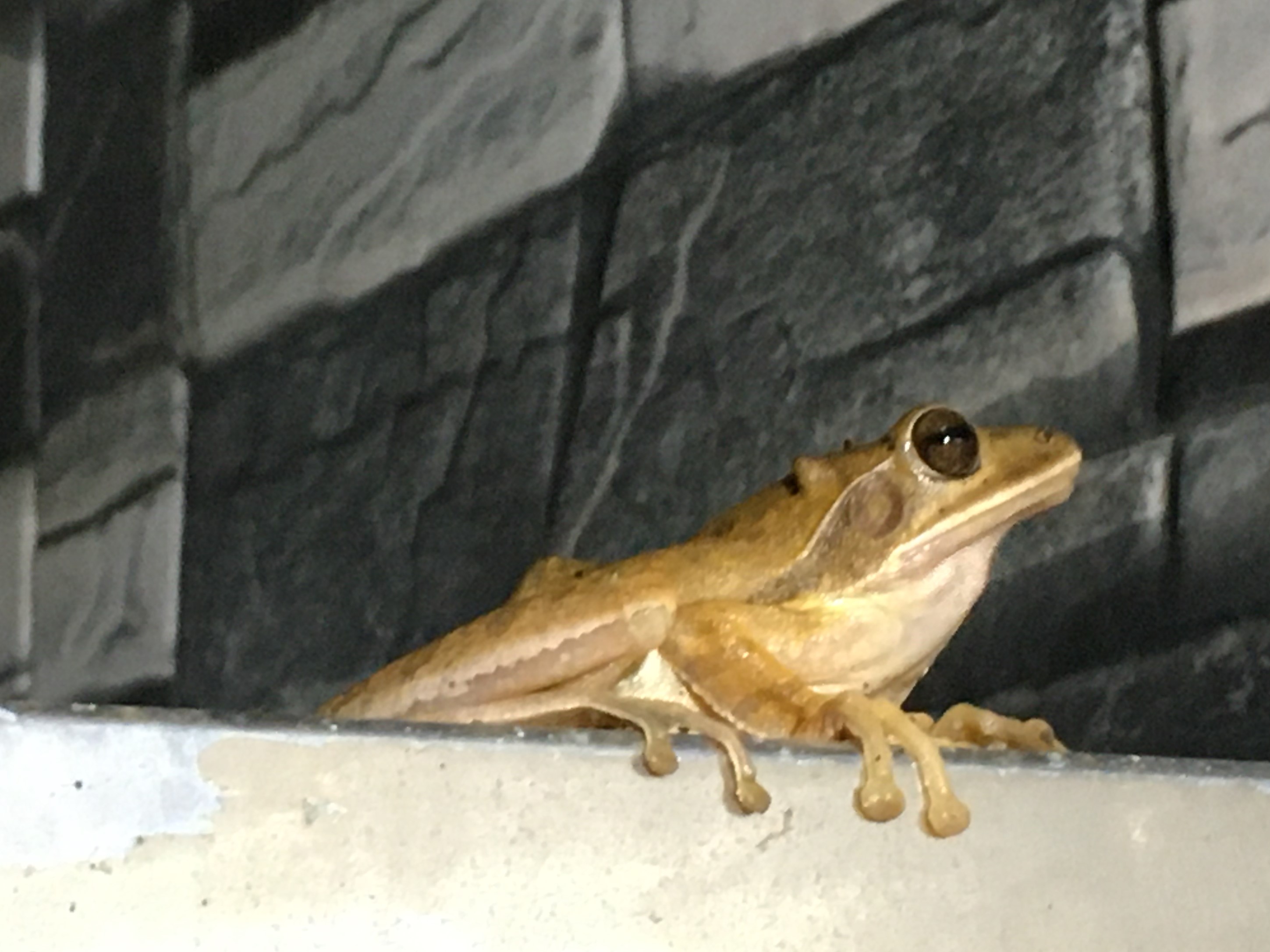
Common Indian Tree Frog Polypedates maculatus - Tanshikar Spice Farm 

Our final night was at Tanshikar Spice Farm (website), which had decent food (as might be expected!) and an interesting range of guest accommodation. Our room was in a building designed to replicate a traditional local dwelling. Even better, there were Common Indian Tree Frogs in the shower room (above). This one was sitting on the shower feed. It wasn't just us: not long after we checked in, the occupant of the room next door stuck his head out of the door and asked me “Have you got a frog in your bedroom? We’ve got five!” 

Tanshikar Farm Shop

Approach to Tanshikar

Tanshikar lunch

After the obligatory small cup of extremely hot tea we were out again at 3.45pm.  First stop was just around the corner, the Budbud Tali temple and bubbling pond.  A few people were gazing at the pond (the idea is that you clap to produce the bubbles; they are fact natural) but we were there because Omkar was looking for White-bellied Blue Flycatcher on the adjoining stream. None were there, but we did see a Malabar Pied Hornbill and five Nilgiri Imperial Pigeons (two pictured below) in a Fishtail Palm.

Nilgiri Imperial Pigeons (one hiding at the back) - Netravali

The road from Budbud Tali temple entered Netravali Wildlife Sanctuary at the Mangal Gate. We passed through the forest quickly, noting two Malabar Grey Hornbills on the way, before leaving the protected area again at the Ambe Ghat checkpoint, which was perched on a forested pass through the hills. The road dropped down to the valley floor, where we were back in the land of paddyfields and scattered settlements. This was Gaondongrim, our final daylight birding location of the trip ... and that daylight was starting to fade away.

As expected, Gaondongrim gave a good boost to the day's bird list (adding about 25 further species), which isn't surprising as it was a very different habitat to the forests of the morning. And there was one species in particular that we were keen to add to the trip list - Black-throated Munia (below).

Black-throated Munia - Gaondongrim

Black-throated Munia has a restricted distribution, being limited to three populations – Western Ghats, east India and Sri Lanka. Several were perched on a wire, with others eating seeds in a nearby rice paddy. Paddyfields attract munias: there were also plenty of White-rumped Munias around. And some larger birds, too: a Crested Serpent Eagle (below) caused a stir when it flew in and vanished into the foliage of a tree.

Crested Serpent Eagle (record photo) - Gaondongrim

An Ashy Woodswallow (below) sat obligingly on one of the electricity wires; you can just about see the contrast between its pinkish-grey underparts and darker grey head. Other birds here were: Long-tailed Shrike; Pied Bushchat; Brahminy Starling; Wire-tailed, Red-rumped and Barn Swallows; Oriental Turtle-dove; Indian Cormorant; Malabar Lark; Little Swift; Common and Jungle Mynas; Yellow Wagtail; Little Egret; Tree Pipit; Indian Pond Heron; Black-headed Bunting (another first for the trip); Indian Roller; Coppersmith Barbet; and a Shikra.

Ashy Woodswallow (record photo) - Gaondongrim


It was now getting dark; Omkar drove us back up to the sanctuary checkpoint for a wander up and down the road in the gloom. We could just make out a Blue-capped Rock Thrush, while a langur monkey jumped from tree to tree above us. Omkar had stopped here for a reason. He managed to lure in an Indian Scops Owl, giving us close views of this lovely bird, which flew in to a nearby branch looking a bit irritated. No photo unfortunately. We walked back up to the checkpoint; Omkar swept his flashlight along the muddy bank above the road and found this sensational White-banded Ground Gecko (below), another Western Ghats endemic (and indeed local only to Goa and nearby parts of Karnataka and Maharashtra). 

White-banded Ground Gecko Cyrtodactylus albofasciatus - Netravali

Back at Tanshikar Spice Farm it was time for our last evening meal of the trip, but not my last Goan curry, as I was able to take a range of spices from the Tanshikar shop back home to the UK. My last wildlife sighting was of a magnificent moth that had arrived in the bedroom - Eudocima aurantia (below), a fruit-sucking moth in the Erebidae family (which includes familiar UK species such as the tiger and footman moths). This species ranges from India east to Australia. (Thanks to Phil Sterling for nudging me in the direction of this identification.)

Fruit-sucking moth Eudocima aurantia - Netravali

An early start on the Sunday morning (it was still dark when we left the spice farm), was followed by a drive to the airport at Dabolim, where we had to talk our way into the terminal past an armed guard who had no knowledge of our flight back to London.  (“No international flights today!”) This was not a good moment, and was indicative of the chaos that Covid-19 pandemic had caused to the Goan tourist industry. But the flight was indeed scheduled, and some scouting around the terminal eventually yielded the location of a check-in desk. As soon as we were queueing up to check in there was a technology failure which caused a long delay – solved by the airline staff issuing handwritten boarding cards and baggage labels.  

Empty (almost) flight back to London

It was a 9½ hour flight back to Gatwick, picking up a tail wind over Europe. I have never been on such an empty plane (above); it was perhaps an eighth full, as it only contained the people on our outbound flight who had stayed for just a week. That meant that there was plenty of room to stretch out, get some sleep and think about what had been an excellent trip. 


Friday, March 29, 2024

Goa 2022 - Netravali: Endemic Birds, Vine Snake and Leeches!

Saturday 12 November 2022

Common Vine Snake - Netravali

Day 7 - the final day of the trip

Another early start: we were up and packed for 0545, to be greeted by Omkar and the usual flask of hot milky tea provided by the Nature's Nest staff. The aim was to do most of the driving before sunrise, so that we could start birding early at Netravali. As light dawned, we started to see birds from the car: a Greater Coucal on a post and three flying Asian Openbill Storks. Just before the entrance to the wildlife sanctuary, Omkar pulled off the road and stopped by an open area next to the forest.  

First stop - Netravali Wildlife Sanctuary

Netravali Wildlife Sanctuary - Mattoni Gate

There was a lot of bird activity here: Forest Wagtail, Asian Koel, Brown Shrike, Ashy Drongo (eating a dragonfly), Blyth’s Reed Warbler, Oriental Green Bee-eater and a flock of Chestnut-headed Bee-eaters, Yellow-browed Bulbul, Purple Sunbird, four Plum-headed Parakeets, Greater Racquet-tailed Drongo, Indian Golden Oriole, two Malabar Pied Hornbills and an Indian Blackbird.  None of these were new species for us, which was a measure of how much we had already seen in just six days.  However, two new species did turn up. The first was a flying Rufous-bellied Eagle (below).

Rufous-bellied Eagle (record photo) - Netravali

At first glance, my photos of this raptor were simply black silhouettes, giving very little away. However, editing reveals the dark hood as well as the rufous colour of the underwing coverts. although it may not be obvious here! This is another one of those species that ranges over a lot of south east Asia and Indonesia, but has a fairly restricted distribution on the sub-continent, essentially the Western Ghats and north east India. We also tracked down a Black-naped Oriole which is a winter visitor to India, breeding in Indonesia and south China, but not common. 

From the Mattoni Gate the road climbed steeply into the sanctuary; this was the first time that we were to gain some height in the Western Ghats. We passed through what looked like a fantastically diverse forest before stopping near to an outlook which gave us a view over the forested mountains. Birds here included Oriental White-eye, Nilgiri Flowerpecker and Orange-headed Thrush. 

Western Ghats panorama - Netravali

Back in the car, the road descended for a bit before passing through a village, one of a few lying within the protected area. On the far side of the settlement we stopped under a large fig which Omkar identified as a Mysore Fig Ficus drupacea.  The tree attracted a range of avian visitors, including a Malabar Barbet (below) that was stuffing its bill with the ripe orange fruit.  

Malabar Barbet on Mysore Fig - Netravali


Malabar Barbets may be messy eaters, but these beautifully patterned birds are a real local speciality, being Western Ghats endemics. Several other birds visited the tree while we watched from below: White-cheeked Barbets, a male Crimson-rumped Sunbird and White-browed Bulbul.

We drove a bit further up the hill before stopping again. There was movement in the trees above the road, and we were able to pick out a pair of Orange (aka Scarlet) Minivets. A walk along a contour-level track produced three new species in succession, the first of which was a group of Rufous Babblers in a small cashew plantation.  (We were still not far from the village, so this wasn’t pristine forest.)

Rufous Babbler - Netravali

The Rufous Babblers were making a bit of a racket, as babblers do. We had excellent views, which was unusual as it is apparently rare to see one out in the open. This is yet another Western Ghats endemic species. The field guide points out the contrasting colours of the two mandibles as an identification feature, but it doesn't mention Omkar’s favourite feature – their ‘yellow lipstick’!  

I wasn’t able to get decent images of the other two new species. Golden-fronted Leafbird represented another new bird family for me (the Chloroseidae), while an elusive Indian Scimitar Babbler finally appeared through a gap in the vegetation showing its striped head and curved bill. Also here was a Loten’s Sunbird and another new butterfly – the Common Sailor Neptis hylas (below).

Common Sailor Neptis hylas - Netravali

The road climbed higher into the forest. We parked at a lay-by, just as a Malabar Whistling Thrush broke with its usual skulking habits and flew right across the road in a flash of blue. It is a more common species than I had initially realised. We walked down a path through semi-evergreen forest, now feeling quite humid and sticky, and stopped by a stream at the bottom of the valley. Sitting on a leaf, and looking very like a butterfly, was an attractive day-flying moth: Dysphania nelera (below).

Dysphania nelera having a drink - Netravali

The moth doesn’t seem to have a common name, but is in the same family (Geometridae) and genus as the more common Blue Tiger Moth D. percota that we had seen the previous day at Tambdi Surla. The yellow edging to the hindwings is the diagnostic feature for D. nelera; some authorities group this with D. palmyra – although that lacks the distinctive marginal yellow spotting. (Information from the useful Moths of India website.)

The stream was quiet for birds, the highlights being a small group of Western Crowned Warblers and a Black-naped Monarch. Two small Leaping Frogs Indirana sp. (below) hid in a crevice between the boulders. Their long jumps when escaping from trouble are the source of the name. Some 14 species are described, all Western Ghats endemics. It’s difficult to identify them to species level; indeed, a new species (the Netravali Leaping Frog I. salelkari) was discovered as recently as 2015.

Leaping Frogs Indirana sp. - Netravali

Just after taking the above photo, I felt something moving above my right sock. I lifted my trouser leg and was startled to find a leech. I instantly pulled it off; it fell on a nearby rock and began to make a bid for freedom.  I was able to take a quick, but blurry phone photo (below). There are a lot of leech species (hooray), but one possibility is the Indian Leech Haemadipsa sylvestris. I warned the others: Richard checked and found that he’d also been bitten. 

Leech - Netravali

I congratulated myself for having spotted it before it could do any damage. But pride comes before a fall, so I will briefly fast forward to lunch time when I spotted an ominous dark patch on the outside of my right trouser leg. Investigating further I was horrified to discover that I had indeed been bitten by a leech, and it was still bleeding. Worse still, my left sock was caked with blood as a result of two more bites just above my ankle. The sock went in the bin. It took me a while to clean up all of the blood, apply some antiseptic cream and also plasters – the only way of stemming the bleeding. I was simultaneously shocked and fascinated; it looked nicely gory, but I hadn’t felt a thing.  And the culprits were long gone, leaving neat, circular bite marks and a great deal of blood. (I haven't included my photo of the wound for fear that it will breach some blogging guideline on the inclusion of shocking images!) I warned Richard; he discovered bites as well.

With hindsight, it seems barely believable that I’d been losing blood for four hours. I suppose that it’s possible that I (we) had picked up more leeches at a later stop. But the stream was the prime candidate; it was a damp environment, and we had been sitting on moist boulders. And our attention had been diverted by the frogs.  Anyway, it’s all part of the jungle experience and it makes a good tale to tell.  People enjoy hearing about personal discomfort much more than tales of epic wildlife, tropical sunsets and memorable curries. 

We walked back to the car and continued along the road, which turned into an unsurfaced track, and stopped by a waterfall. We could hear the call of a woodpecker in the mature trees nearby, and finally tracked down this female Greater Flameback (below), a species of wet tropical and subtropical forests across the Indian subcontinent and south east Asia.

Greater Flameback (female) - Netravali

We also got a good view of a male Crimson-backed Sunbird (below), another Western Ghats endemic. Spectacular, even if the colours clash with each other a bit (to my eyes anyway).

Crimson-backed Sunbird (male) - Netravali

A couple of butterflies were also showing well.  This Chocolate Pansy Junonia iphita (below), was the third species in this genus that we’d seen on the trip.

Chocolate Pansy Junonia iphita - Netravali

The skipper (Hesperiidae) below is I think Dark Palm-Dart Telicota bambusae; the markings look better for this than for the similar Pale Palm-Dart T. colon, although there isn’t much in it. Skippers can be tricky!

Dark Palm-Dart Telicota bambusae - Netravali

With that, we returned to the car and retraced our route through the sanctuary. Passing through the village we stopped to look at this Hoopoe (below), which at times was so close to the vehicle that I couldn't get the camera lens focussed on it.

Hoopoe - Netravali

Re-entering the forest after passing through the village, we had the best snake encounter of the trip.  This beautiful Common Vine Snake (below) was crossing the tarmac ahead of us. We stopped, blocking the road in case any other vehicles flattened it, and got out to take photographs.  
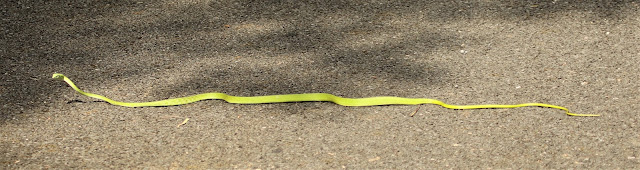

Common Vine Snake - Netravali

Unusually, the snake didn’t make a quick dash for freedom. Instead, it froze. Or rather it almost froze, because if you looked carefully its head continued to sway slightly from side to side. This looked like a really neat camouflage strategy, as the snake would be almost invisible in the canopy leaves where it normally lives and hunts. Unfortunately, this method was considerably less effective on a strip of black tarmac!  After we took some photos, Omkar gently touched the snake’s tail. It wriggled with alacrity into the roadside vegetation, and vanished from sight instantly.

Common Vine Snakes have been the subject of some taxonomic confusion. Grewal et al (2022) give the scientific name as Ahaetulla nasuta.  According to GBIF, this species ranges across India (mostly in the Western Ghats), Myanmar and south east Asia. All well and good. However, there has been some recent splitting going on (Malik et al., 2020); the taxon A. nasuta is now restricted to an endemic species from Sri Lanka. From that paper, the best match for our snake is now Ahaetulla borealis – both in terms of appearance and location. Wikipedia gives this the snappy vernacular name of the Northern Western Ghats Vine Snake.  Anyway, whatever it’s called, it was a lovely thing. The snake is mildly venomous, but being rear-fanged it is less likely to give you a nasty bite. Grewal et al say that the diet is varied, and “includes tadpoles, lizards, birds, small mammals and even leeches”. Good.

Common Vine Snake (detail) - Netravali
 
We left the sanctuary and stopped for lunch at the nearby Tanshikar Spice Farm, which was to be our base for the final night of our Goa trip.

To be continued ...

References


Grewal, B., Mathur, M. & Sood, T. (2022) Wildlife of India. Princeton: Princeton University Press
 
Mallik, A.K., Srikanthan, A.N., Pal, S.P., D’Souza, P.M., Shanker, K. and Ganesh, S.R. (2020). ‘Disentangling vines: a study of morphological crypsis and genetic divergence in vine snakes (Squamata: Colubridae: Ahaetulla) with the description of five new species from Peninsular India.’ Zootaxa, 4874(1), pp.1-62.


Thursday, March 28, 2024

Goa 2022 - Langurs, Kingfishers and Nightjars

Friday 11 November 2022


Black-footed Grey Langur - near Nature's Nest

Day 6

The usual flask of extremely hot, milky tea heralded the start of the afternoon session, and we were soon on the road heading back towards Tambdi Surla temple.  Just north of Nature’s Nest, Omkar stopped so that we could look at a small group of Black-footed Grey Langurs (above and below). They were very mobile, and it was difficult to get a decent photograph. However, these turned out to be the best views that we were to get of langurs in Goa. 

There are two main groupings of Old World monkeys. Langurs are members of the leaf monkey  subfamily (Colobinae) while Bonnet Macaques (see below - and my previous blog post here) are in the Cercopithecinae subfamily along with baboons and vervet monkeys among others. Generally, langurs are leaf-eaters, although they will take food from humans when offered.  Langur taxonomy is confusing; I have followed the IUCN Red List here. What was previously the (almost) pan-Indian Hanuman Langur Semnopithecus entellus has been split into several new species. One of these is the Black-footed Grey Langur S. hypoleucos, which is restricted to western India; essentially, it is yet another Western Ghats endemic species. It's also known as the Malabar Sacred Langur, which is a rather cooler name. 

Being ignored by a Black-footed Grey Langur

We left the langurs and drove once again up the road to the Tambdi Surla temple, pausing to finally get Richard a view of an Orange-headed Thrush, a species that he had missed so far. Mind you, its skulking behaviour meant that I was never able to get a photo of this attractive species. I then missed an Indian Blackbird; luckily, we were to find another one later on.  Back at the temple car park, the stall holders were packing up and the place was a lot quieter. Even the Bonnet Macaques were looking tired.
 
Bonnet Macaque male - Tambdi Surla

Bonnet Macaque - Tambdi Surla

This time we didn’t get as far as the temple, walking instead along the (true) left bank of the Surla River upstream from the bridge.  Our first sighting was a brief flash of a Blue-capped Rock Thrush, this time on a rock by the river before it flew.  But then we spotted our main prize – this Blue-eared Kingfisher (below).  We watched it for a while; it flew a couple of times, but never very far, always keeping to the river or its side streams, and we were able to relocate it.  Annoyingly, it seemed to prefer sitting in the shade; this image has a high ISO so is too grainy for my liking.  Blue-eared Kingfisher has a wide range in south east Asia and Indonesia, but is rare in India, being restricted to forest streams. Note that the ear coverts are blue, the main identification feature that separates it from the (very) Common Kingfisher.  A little gem of a bird, and worth the effort that it took to find it.

Blue-eared Kingfisher

The light was starting to go, so we returned to the car and drove back down the temple road, making a few stops to look for an Oriental Dwarf Kingfisher, which was one of the birds that we never got to see on the trip. A small sports pitch produced an Indian Peahen and Cattle Egret, with Pied Bushchat, Oriental Turtle Dove and Thick-billed Flowerpecker being added to the day list shortly afterwards.  Omkar drove us back to the main road and parked up in a layby just north of Nature’s Nest. A walk into the forest, looking unsuccessfully for owls, gave us views of Malabar Whistling Thrush and my first Indian Blackbird; the record photos are too awful to include here! 

Sunset near Nature's Nest

From the forest we climbed up to an area of west-facing plateau to look for nightjars. We sat down to wait for nightjar o’clock (below). This was a large expanse of open and sparse grassland land with almost no soil. Bare laterite rocks dotted on the surface with a larger boulders and isolated trees. We watched the sun setting over the forested ranges to the west (above).


Waiting for nightjars ...

The nightjar stakeout did not go entirely as planned. As the skies grew ever darker we heard the weird, whooping call of Jerdon’s Nightjar, and set off to try and locate it. Plot spoiler: we failed. As we crossed a small outcrop of boulders, Omkar pointed out a beautifully patterned Indian Saw-scaled Viper, burrowing into a rocky crack. This is a seriously dangerous snake, one of India's 'Big Four' (the others being Indian Cobra, Common Krait and Russell's Viper); and responsible for many deaths each year. But, as with most snakes, it just wanted to get away from us. 

We carried on walking across the grassland, which wasn't easy in the dark - especially following the sprightly Omkar. We heard, but didn't see, an Indian Scops Owl (happily another one turned up the next day). But eventually the eyeshine of a nightjar flashed in the torchlight and I managed to get a record photo (below). This was actually a Jungle Nightjar, not Jerdon’s.  Although a poor image, it does give an idea of the bird's main characteristics. Jungle Nightjar is generally greyer than Jerdon’s; it is pretty much endemic to India and Sri Lanka. So is Jerdon’s, but with a more restricted distribution. We walked down the hill, and then back up again in an abortive search for Jerdon’s Nightjar. Four more sets of eyeshine all turned out to be Jungle Nightjars. I returned to the car in a pool of sweat. Jerdon's Nightjar, which had been seen the previous evening by another group staying at Nature's Nest, remains a 'bogey bird' for me.

Jungle Nightjar (record photo) - near Nature's Nest

I was exhausted, and pleased to get back to Nature’s Nest for a shower, a rest and then another great evening meal, washed down with a Kingfisher beer (which seemed apt for the day!).  All excellent but, as with the previous day, I had eaten such a large lunch that I couldn’t do the evening meal justice.  Improbably, a very recognisable moth flew in – Olive-tree Pearl Palpita vitrealis, the species for which my blog is named. It has a wide global range (see GBIF distribution map here). I didn't take a photo at the time, so here's one from my garden moth trap here the UK. 

Olive-tree Pearl Palpita vitrealis - Dorset, UK

This was to be our last night at Nature's Nest. Our journey was to continue in the morning to perhaps the best wildlife area that we visited on the trip - the magical Netravali.

To be continued ...


Wednesday, March 27, 2024

Goa 2022 - Nature's Nest and Tambdi Surla

Friday 11 November 2022


Chestnut-headed Bee-eaters in the morning sun - Talde

Day 6 

Morning at Nature’s Nest. After a good night’s sleep, it was a lovely cool start to the day with a restful breeze. Omkar arrived around 0645, tea was served very hot from a flask with a sweet biscuit.  Omkar announced that "the aim today is to target certain species, not to go for numbers.”  And that was broadly how it turned out, although a quick birdwatch from the resort's car park produced Oriental Magpie-Robin, Common Iora, Vernal Hanging Parrot, Brahminy Kite, Purple Sunbird, Blyth’s Reed Warbler, White-breasted Kingfisher and Large-billed (Jungle) Crow, which wasn’t a bad start.


First main stop of the morning was a return to the hamlet of Talde, where we'd finished the previous night. Getting there required us to gently dislodge a couple of dogs that were asleep on the tarmac and negotiate a cattle jam blocking the lane. We left the car and walked up a path past a few smallholdings - the village sits in a small cleared area completely surrounded by forest.  We stopped to look at some Chestnut-headed Bee-eaters (see photo at the top of the blog) that were highlighted in the morning sunshine. One had already sorted out its breakfast. It was at this point that we got our only sighting of the much sought-after Blue-headed Bee-eater. Annoyingly, it was flying rather than perched, but it was still very distinctive: large, with a long, flat and extended profile. Its flight was direct and purposeful, unlike the hawking movements of most other bee-eaters. 

Also nearby were Black-rumped Flameback, White-cheeked Barbet, my first Chestnut-shouldered Bush Sparrow and a couple of flying Crested Treeswifts. The treeswifts were a new family for me, the Hemiprocnidae, which contains just four species all in the same genus.  Crested Treeswift is the most widely distributed of these, found across much of India and south east Asia. The key identification features were easily seen – a deeply forked tail and white vent area.  Unlike ‘true’ swifts (Apodidae), treeswifts do perch in the trees, although we only saw them in flight.

After a quick stop in a lay-by for breakfast 'on the go', we returned to the forests along the road to the Tambdi Surla temple. The main avian excitement here was the arrival of a White-bellied Woodpecker (below).  As ever, I was slow to get onto it – what is it with me and woodpeckers? But it was still lovely to see.  This is a Dryocopus woodpecker, the same genus as the enigmatic Black Woodpecker, which I have only encountered in the Netherlands.  White-bellied Woodpecker is widely distributed across Indonesia and south east Asia (as its scientific name of D. javensis might suggest), but within India it is restricted to the Western and Eastern Ghats.  The white underside is visible in the photo.  We also managed a fleeting glimpse of a Heart-spotted Woodpecker, as well as White-rumped Sharma, Greater Racquet-tailed Drongo and a fly-over from a Mountain Imperial Pigeon.

White-bellied Woodpecker - near Tambdi Surla

We returned to the car and drove on, stopping in a scatter of settlement that didn’t look too promising for birdwatching.  But there were birds around, including a Brahminy Starling (below), which a subcontinent endemic, and a juvenile Rosy Starling (bottom) - also known as Rose-coloured Starling, a species that occasionally strays as far west as the UK. One spent some time on Portland in Dorset in 2020, for example. Also here was a Red-breasted Flycatcher - also, like Rosy Starling, a winter visitor to Goa.

Brahminy Starling - near Tambdi Surla

Rosy Starling (juv) - near Tambdi Surla

We hopped back into the car (it was turning into that sort of day) and continued along the road towards the Tamdi Surla temple, stopping for a further short walk into the forest which produced good views of a Flame-throated Bulbul (below). We had already seen this species at Bondla Wildlife Sanctuary, which is endemic to the forests of the Western Ghats, but it was good to get a better image.

Flame-throated Bulbul - near Tamdi Surla

A Roux’s Forest Lizard (below) Monilesaurus rouxii - also known as Sahyadri Forest Lizard - was lurking on a tree trunk nearby. The distribution of this species follows the Western Ghats range right down the western side of India, so it may well be another endemic to this biodiversity 'hot spot'. In researching the reptiles that we saw on the trip I have made extensive use of The Reptiles of India website - an excellent resource, including distribution maps and a good range of photos.
 

From the temple car park we followed the river upstream, in what turned out to be (for the moment) an unsuccessful search for a Blue-eared Kingfisher. (Actually we did get an extremely fleeting view of one zooming away up river, but it was too quick to really count.) We resolved to return later that day, and were making our way back by the river when Omkar suddenly called out “snake!”.  Ahead of us, the head of a large snake was sticking up from between the boulders - an Indian Rat Snake Ptyas mucosa. On spotting us it dipped back down and made a speedy escape across the water.  I was only able to get a photo as it vanished into the tree roots on the opposite bank .  Not ideal, as a snake picture without the head is pretty underwhelming.  The species is widely distributed from Iran to southern China and is also known as the Oriental Rat Snake or Dhaman.  It is common, non-venomous and large; this one was easily 2 metres long (the record is apparently 3.7 metres).  Its diet includes frogs, rodents and birds.

Indian Rat Snake (part!) - Tamdi Surla

And with that, our morning excitements were over. We returned to Nature's Nest for a simply huge lunch, and an afternoon siesta.

To be continued ... 


Monday, March 25, 2024

Goa 2022 - Spiderhunter and Frogmouth

Thursday 10 November 2022


Little Spiderhunter (after a bath) - Nature's Nest


The remainder of Day 5 was to bring encounters with two memorable birds that are high on the list of any birding trip to south-western India - Little Spiderhunter and Sri Lanka Frogmouth.

Our base for the next couple of nights was Nature's Nest, an eco-resort located just outside the Bhagwan Mahavir National Park (the resort's website is here). It suited us nicely - rustic and rural, but with good food (no western stuff in sight) and spacious cabins. Best of all, there were plenty of birds around. This Little Spiderhunter was attracted to a water pot that had been strategically sited near the outdoor (covered) dining area. Spiderhunters are in the same family as the sunbirds, but have a proportionally longer bill. They do actually hunt (and eat) spiders - it's not a given: Eurasian Oystercatchers don't catch oysters, for example - but have a much more varied diet of invertebrates and nectar. The HBW/Birdlife Checklist identifies 13 species of spiderhunter (genus Arachnothera), only one other of which occurs in India - Streaked Spiderhunter. Little Spiderhunter is found from north east India through to south east Asia, so its presence here in the Western Ghats is a bit of an outlier. This one looked positively punky as it emerged from its bath. Here it is before it went in:

Little Spiderhunter - Nature's Nest

The same pot then attracted a Large-billed Crow (below). Not the first of the trip, but it was good to get a decent view at last. The common Indian crow is the House Crow, the two-tone appearance of which is similar to the hoodies of Scotland. Large-billed Crows proved to be more elusive: they remind me of a smaller Carrion Crow, but with an obviously curved culmen (top of bill) and more massive bill. The HBW/Birdlife Checklist lumps Large-billed Crow into one species with 13 subspecies, but notes that a “break up seems almost inevitable”.  In most of India, this is called the Jungle Crow; Grimmett and Inskipp separate it in two species - Indian Jungle Crow (our one here) and Eastern Jungle Crow.

Large-billed (Jungle) Crow - Nature's Nest

I was enjoying some peaceful downtime in the restaurant area when there was a sudden commotion. Somebody had spotted this Common Hawk Cuckoo (below) which was sitting low in a tree by the path to our cabin.  It seemed improbable that a cuckoo would just fly in and perch like this – but there it was.  Maybe it had been attracted by the availability of water, too. The species is widespread across most of the Indian sub-continent, to which it is almost endemic, although it is also found in Myanmar. 

Common Hawk-cuckoo - Nature's Nest


Come 3pm we set out again. A short drive took us to woodland on the edge of the Bhagwan Mahavir (or Mahaveer) National Park. There were no entrance formalities at the gate on this road, a cul-de-sac leading to a few villages and the historic Tambdi Surla temple - a major local visitor attraction.


There were five new birds for me here - and I have decent photographs of none of them! It was very much a case of peering through thick, evergreen undergrowth, with intervening leaves and branches. For the record the 'lifers' were: Orange-headed Thrush, Malabar Trogon, Asian Fairy Bluebird, Bronzed Drongo and Greater Racquet-tailed Drongo. Further up the road, we stopped at another fig tree - and were in luck: two Malabar Pied Hornbills had arrived for dinner. They flew when we got out of the car, but I was able to get a record photo (below) when one landed on another tree nearby. Despite its name, the species is not restricted to the Western Ghats, and is found in north east India and Sri Lanka. It is similar to the widely-distributed Oriental Pied Hornbill (which also appears in north east India, where the ranges overlap), but with a darker casque that has a pronounced forward point.

Malabar Pied Hornbill (record photo) - near Talde

The light was starting to fade, and photography was getting even harder. We made several stops on the road up to the temple car park, adding Chestnut-headed Bee-eaters, Red-throated (Taiga) Flycatcher, Nilgiri Imperial Pigeon, Malabar Parakeet and Malabar Barbet to the trip list.

We were now killing time, waiting for things to get really dark.  Omkar drove us around the streets of the nearby village, looking for – and eventually finding – a roost of over 100 Chestnut-headed Bee-eaters, which were occupying trees near a small temple. Our first Black-footed Grey Langur then appeared, walking nonchalantly along an electricity wire. 

Once the sun had finally set, we parked in a lay-by, donned head torches and set off up a forest trail. After a hundred metres or so, Omkar stopped and played the call of a Sri Lanka Frogmouth, which   provoked responses from three birds.  Omkar followed one call, and we followed Omkar, off the path and into the forest.  And we found it (below).  These are brilliant birds; small and chunky, but exuding personality.  Obviously, they aren't restricted to Sri Lanka, but the Western Ghats are the only part of its range on the mainland, so it was great to see.  According to the HBW/Birdlife Checklist there are 14 species of frogmouths, ranging from India to Australia.  It is hard not see them as Old World equivalents to the potoos, which look similar and have similar habits - including doing very little at all during the day. My favourite bird of the whole trip, I think.


Sri Lanka Frogmouth - near Surla

It was difficult to top that, but Omkar had a go, taking us to the small hamlet Talde, where his expedition company has a base. A Brown Hawk Owl (Brown Boobook in the HBW/Birdlife Checklist) was perched on a stump over the road from the building, one of a pair that come there regularly.  The other was sitting across the field.  There was more to come.  Omkar darted up a small track and shone his flashlight into the adjoining trees, before beckoning us urgently to follow. High in the branches, a large grey squirrel was moving slowly through the leaves – an Indian Giant Flying Squirrel.  Sadly, it didn't fly.  Despite its name, the species has only a patchy distribution across India, having a more cohesive range within south east Asia, southern China and Taiwan.  They eat fruit, flowers and bark.  

We then headed back to Nature’s Nest, to find that England had beaten India in the T20 Cricket World Cup semi-final. Everybody was very nice about it, though. There was time for a (cold) shower before the evening meal and (in our cases) a well-earned beer. It had been a great wildlife day, made more special by the fact that we were now staying in an extremely wildlife-friendly location. 

To be continued ...


Vive la différence: an Anjou moth trap

Four-spotted Tyta luctuosa - Anjou, France France is our favourite holiday destination. An easy hop over the Channel from Dorset opens up a ...