Sunday, March 17, 2024

Goa 2022 - Salvador do Mundo wetlands

Monday 7 November 2022

Indian Garden Lizard - Salvador do Mundo

Day 2, continued ...


It was a short drive from the Socorro Plateau down to the wetlands near the church of Salvador do Mundo, a relic of Goa's Portuguese colonists. Water levels were very high (the site is probably tidal), leaving very little exposed mud suitable for waders or shorebirds.  But all was not lost.  Prakash parked at the start of a causeway across the flooded area; nearby a lone Red-wattled Lapwing (below) stood on the top of a concrete retaining wall.  A smart bird, its range extends from Mesopotamia to south east Asia.

Red-wattled Lapwing - Salvador do Mundo

View from Salvador do Mundo wetlands

We left Prakash and the taxi, and headed down a track that ran between two waterbodies. As with all of the Indian wetlands that we visited, a number of the birds were distinctly familiar, in this case Common Sandpiper, Little and Great Egrets, Grey Heron, Greenshank, Common Kingfisher, Stonechat, Barn Swallows, Purple Heron and a distant perched Osprey.  But others were more exotic, including a Little Cormorant (below) that seemed untroubled by our presence, allowing a portrait to be taken. It’s showing the brownish non-breeding plumage; breeding adults are black.  Little Cormorants are the commonest (and the smallest) of India's cormorant species.

Little Cormorant - Salvador do Mundo

Scanning the skies was a good idea here, as an Asian Openbill soon wheeled into view.  U
nlike their African cousins, Asian Openbills have black and white plumage and a lighter-coloured bill with less of an obviously open gape.  It is a common species of wetlands across most of India (but not Pakistan) and its distribution is scattered through the rest of tropical Asia.  A few minutes later it had been joined by a much larger Lesser Adjutant; the lower image shows the size difference. The two Adjutant species are in the same genus as Africa’s Marabou Stork – Leptoptilos. But unlike the Marabou, both species are under threat.  Greater Adjutant, which has a very restricted distribution in Assam and Cambodia, is classed by the IUCN as ‘endangered’, while Lesser is merely ‘vulnerable’ – which is bad enough, so it was great to see one.  Lesser Adjutant is a solitary species; its main food is aquatic animals (frogs especially, I would guess) unlike Marabous – which will eat almost anything. 

Asian Openbill - Salvador do Mundo

Lesser Adjutant (below) & Asian Openbill (above)

We continued along the path, which turned  out to be a dead end.  Omkar’s sharp eyes spotted an Indian Garden Lizard Calotes versicolor (photo at the top of this blog) trying to blend in with the foliage.  What a fantastic reptile!  We discovered that they are fairly common, being found all over India; a few more were to turn up on the trip.  But that doesn’t reduce their wonderfulness.  Indian Garden Lizards are classed within the Agamidae (agamas) rather than the Lacertidae (true lizards).  Agamas (or ‘chisel-teeth lizards’) are the Old World counterpart of the iguanas.  The difference is apparently in their respective tooth arrangements, although (and I may well be wrong about this) agamas have a distinct ‘look’ that separates them from the sleeker lacertids.  Also called the Changeable Lizard, Calotes versicolor can change colour; the males turn red and black in the breeding season.

We retraced our steps and Prakash drove us to another part of the wetland, where a road crossed the paddyfields.  These had been recently harvested and several waders were pecking around in a cleared area next to the road.  Two species were present.  The first, Temminck’s Stint (below) is a bird that I’ve only seen once before - in  the UK - and that wasn’t a great view.  It’s a rather plain wader; in fact, its uniform plumage is one distinguishing factor between it and the almost similar Little Stint. But the key give-away is the yellowish leg colour.  Temminck’s Stints are common winter visitors to India.  They breed in the Arctic – from Scandinavia east to the Bering Straits - a huge contrast to this tropical wetland.

Temminck's Stint - Salvador do Mundo

The other species probing the mud nearby was a Wood Sandpiper (below), which is also much more common in Goa than back in the UK.  Wood Sandpipers also breed in a wide band of boreal forest and tundra between Scandinavia to the Bering Straits, but occupy a broader and generally more southerly breeding area than Temminck’s Stints. 

Wood Sandpiper - Salvador do Mundo

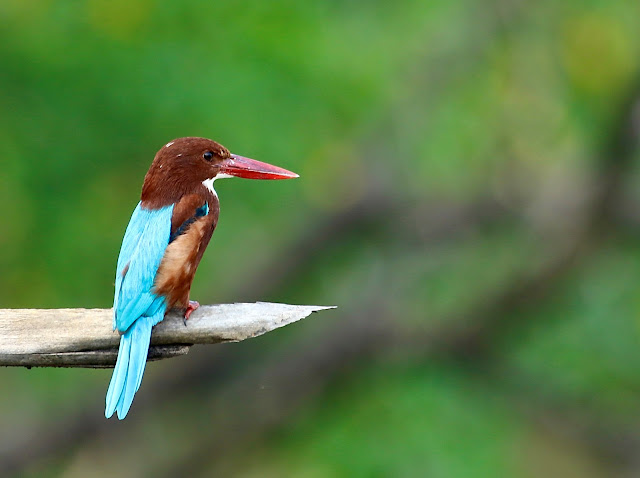
With that, Prakash drove us back to Arpora.  A late afternoon walk took us down to the coast at Baga, a hive of activity with booming music from the beach bars and fishermen landing their catches at the river mouth.  It was getting late for photography, but we got a brief glimpse of our first White-breasted Waterhen on exposed mud next to the Baga River, and had much better views of a White-breasted Kingfisher (below) sitting on a palm frond above the water.

White-breasted Kingfisher - Baga River, Arpora

To be continued ...

Friday, March 15, 2024

Goa 2022 - Socorro Plateau

 Monday 7 November 2022


Hoopoe - Socorro Plateau
Hoopoe - Socorro Plateau 

Day 2. We had arranged an early pick-up from the hotel, but Prakash didn’t turn up until seven o’clock.  The delay gave us the chance for a quick birdwatch while it was getting light, and we soon located a male Purple-rumped Sunbird (below), one of a pair busily feeding on the flowers of roadside bushes.  This is a species of South and Central India, as well as Sri Lanka and Bangladesh.  Nearby was our first Green Warbler, a common but (I’m afraid) undistinguished Phylloscopus warbler that overwinters down India’s western coastal strip.  It’s very similar to the Greenish, Large-billed Leaf and Western Crowned Warblers that we saw later in the trip - a group posing some identification problems.

Purple-rumped Sunbird (male) - Arpora

I was also able to (just) snatch a photo of a Three-striped Palm Squirrel (also known as the Common Palm Squirrel), one of two that were moving through the trees and shrubs.  This is the common urban squirrel of peninsular India, and has a shrill call that could perhaps be confused for a bird.  In Northern India this species is replaced by the Five-striped Palm Squirrel which has two additional stripes along its flanks.

Three-striped Palm Squirrel (record pic) - Arpora

Prakash eventually appeared, looking suitably apologetic, and we headed off quickly, catching a speed bump that catapulted my head against the the roof of the taxi.  I was still grumbling when we collected Omkar from a lay-by near national route 66.  After a few turnings we found ourselves bumping up a dead-end track that climbed through thick woodland before emerging at the edge of an open prairie. Thin, tinder-dry yellow grass dominated the view, broken up by flat outcrops of red laterite rock.  This was the Socorro Plateau, one of several higher areas in coastal Goa where the soil is too thin, and the ground too dry, to enable either woodlands to establish or farming to take place.  Instead, it acts as a communally-owned open space.  And it was surprisingly good for birds.

View across the Socorro Plateau

For sheer star quality in the Indian bird world, it’s hard to look further than the Small Minvet (below), a pair of which flew into a fruiting tree near where Prakash had parked.  They are common birds of the subcontinent and SE Asia, but none the worse for that. Taxonomically, they sit in the Camephagidae family – the cuckoo-shrikes, which are not related to either cuckoos or shrikes.  But their hooked bill is reminiscent of the shrikes, and their diet is mainly arthropod-based, especially caterpillars.  The male Small Minivet is a simply stunning bird.  

Small Minivet male - Socorro Plateau

On a more distant tree sat two White-bellied Drongos (below), the only ones that we were to encounter on the trip.  This species is endemic to India and Sri Lanka.  An Indian Golden Oriole flew past; these cropped up at regular intervals during the rest of the trip, but proved hard to photograph.  A small but noisy group of Jungle Babblers were on the move between trees, bushes and grass thickets. India is a good place to find babblers, and Jungle Babblers are some of the most common, widespread and characterful.  There will be more in a later blog post. 

White-bellied Drongos (record pic) - Socorro Plateau

We had hardly moved from Prakash’s taxi, but new species kept in appearing in the surrounding trees.  I saw, but got no decent photos of, Oriental Magpie-robin, Grey-headed Bulbul, Purple Sunbird (more of those later), Blyth’s Reed Warbler, Black-headed Oriole, Indian Robin, Common Woodshrike and Black-headed Cuckoo-shrike, the last of these looking more like the monochrome cuckoo-shrikes that I have seen in Australia than the gaudy minivets.  My first Black Drongo (below) perched up nicely, giving good views of its white rictal spot, rictal bristles and shiny black plumage.  Unlike Ashy Drongo, which is a winter visitor to Goa, Black Drongo is a year-round resident across much of the Indian subcontinent.  Its range extends east to China and Java. 

Black Drongo - Socorro Plateau

Omkar is a keen herpetologist, and was keen to point out a number of small frogs ranged around the edge of a temporary pond in a rocky dip nearby.  These were Skittering Frogs (below), which blended so well with the pond margins that they only became visible when they dashed (or skittered) into the water.  Dragonflies were also attracted to this rare water source, including Globe Skimmers Pantala flavescens – a reddish migratory species with an wide world distribution.  

Skittering Frog - Socorro Plateau

It was time to set off across the plateau; the dried up grassland didn’t look very promising for birds, but we’d seen enough already to know different.  Oriental Skylark was added to the day list, looking and behaving much like its Eurasian cousin.  Also the attractive Red-whiskered Bulbul (below), a commonplace bird of India, and indeed southern Asia generally.  Other bulbuls seen on the plateau were Red-vented and White-browed.

Red-whiskered Bulbul - Socorro Plateau

A Long-tailed Shrike (below) was also perched conspicuously.  This is a widespread resident across much of the subcontinent and is is also found in China, south east Asia and Indonesia.  It is noticeably larger than the (sadly declining) Red-backed Shrike of Europe.

Long-tailed Shrike - Socorro Plateau

The sight of our first Indian Peafowl (below), a female, making her way through the grass caused some excitement, as it was another of my target species for the trip.  Peacocks are such a common sight in various stately properties of the UK that it's easy to forget that somewhere in the world they are wild birds.  Well, that somewhere is here.  It is a mainly Indian species, its range only extending into Sri Lanka and a small part of Pakistan.  Being wild birds, and subject to hunting, they don’t hang around. Obviously, the male is one of the most extraordinary birds of the world – if rather taken for granted. We saw one later further inland.  But at least they are not threatened, being listed as ‘least concern’ by the IUCN.  The Peahen paused briefly, as if to allow photos, and then stalked off into the long grass.

Indian Peafowl - Socorro Plateau

The next birds were rather more familiar.  A female Common Kestrel perched in a tree, while a Common Cuckoo flew past – they overwinter down here.  The first pipit of the trip turned out to be Tree Pipit - we were later to see Blyth's and Tawny.  A flying Hoopoe obligingly sat in a bush right in front of us (see the photo at the start of the blog). These lovely birds are year-round residents in Goa.  

The European theme continued with an exciting fly-past of a Pallid Harrier (below).  Not a good photo – it was moving fast – but it does show some of the key field marks, notably the black wing tips and the absence of the black band across the secondaries that would denote Montagu’s.  Pallid Harrier is the commonest of the ‘grey’ harriers in Goa.

Pallid Harrier - Socorro Plateau

Lurking at the bottom of an Indian Charcoal Tree was a male Tickell’s Blue Flycatcher (below).  This beautifully-coloured flycatcher is endemic to India and Sri Lanka, and was probably the commonest of the blue flycatchers that we were to see on the trip.  They never gave a good view, though.

Tickell's Blue Flycatcher - Socorro Plateau

I was surprised when an Indian Pond Heron and White-bellied Sea Eagle flew over the arid landscape.  However, there is a large wetland nearby, which was to be our next destination of the morning.  This may have explained the presence of a Brahminy Kite (below) one of three perching on a dead tree.  I never tired of seeing these magnificent raptors.

Brahminy Kite - Socorro Plateau

We had already been buzzed by a Peregrine Falcon, which we finally tracked down (below). It has an impressively rufous breast, looking very different to those back here in the UK.  This is the subspecies peregrinator, which ranges from the Indian subcontinent east to China - one of 19 subspecies of Peregrine Falcon that are recognised by the HBW/Birdlife Checklist. 

Peregrine Falcon - Socorro Plateau

By now, we had completed our circuit of the plateau and had returned to the pond.  After a look at some Ground Skimmer dragonflies Diplacodes trivialis, we walked down the track through the forest to a clearing.  This was next to the local crematorium - birding certainly takes you off the usual tourist track!  Flowering bushes on the way down were being visited by plenty of butterflies: we picked out Common Baron Euthalia aconthea and Southern Birdwing Troides minos, the latter a vivid yellow and black papilionid that is apparently India's largest butterfly species. 

Southern Birdwing Troides minos (photo from later in the trip)

The clearing was excellent for birds … but not for photography.  Blue-tailed Bee-eaters whirled overhead and a black Asian Koel retreated into a bush, which seems a characteristic behavioural pattern. A Coppersmith Barbet provided a vivid dot of colour in a large fig, while a Nilgiri Flowerpecker flew over us and landed in a tree up the slope before vanishing into the foliage.  Two more butterflies turned up here: the brilliant blue Malabar Banded Peacock Papilio buddha (another swallowtail) and, bustling around flowers on the verge, several Common Grass Yellows Eurema hecabe.  And with that, Prakash’s taxi came bumping down the track to collect us for the short drive to our next destination of the morning.

To be continued ...


Goa 2022 - Morjim estuary and Siolim Fields

 Sunday 6 November 2022

Brahminy Kite - Morjim estuary

Day 1, continued ...

Having met up with our guide (Omkar Dharwadkar) at the Marinha Dourada hotel, we lost no time in setting out.  Omkar had booked us a taxi and driver (Prakash) for the first four days of the trip.  It was a short drive to our first destination – Morjim beach.  This lies on the north side of the mouth of the Chapora River, which emerges into the Indian Ocean near the northern border of the small state of Goa.  The beach is a well-known site for gulls and waders, but Omkar’s plan for the afternoon was a bit different.  Leaving Prakash for the first of many snoozes, we boarded a boat that took us to a sandbar that had become exposed in the middle of the estuary.

Heading for the boats at Morjim beach.

Omkar had warned us to wear sandals, so we had no problems wading from the boat.  The first thing we noticed was that large areas of sand were covered, and I mean really covered, with tiny crabs. These were Sand Bubbler Crabs, which leave a mass of small sand balls behind on the surface when they filter the substrate for food.  Despite their tiny size (~2cm diameter) they had no shortage of attitude, raising their claws in an attack posture when anyone got close before vanishing down the nearest burrow.  There are several species of Sand Bubbler Crabs occupying two genera (Scopimera and Dotilla) in the family Dotillidae.  The best fit for these ones is Dotilla myctiroides – which has been recorded on the coast of Goa and looks right for these, with a grey body and reddish legs. 


Sand Bubbler Crab - Morjim estuary

Tread carefully!

The crabs were also attracting the attention of a sub-adult Brahminy Kite. The juveniles of Brahminy and Black Kites are difficult to separate.  In this case, the absence of light streaks on the breast points to Brahminy.  There were a number of adults flying over the estuary (see photo at the start of this blog). These birds range from Pakistan eastwards to Australia.  In Goa they were almost ubiquitous, although more common in coastal districts.  

Brahminy Kite (sub adult) - Morjim estuary

However, we weren’t on the sandbar to look for crabs or kites.  We had come to find waders, terns and ducks – and there were plenty about.  This was the point in the trip where I felt the lack of a ‘scope most keenly, having left mine in the UK in favour of the camera; lugging both around seemed too awkward, which is a big advantage of my late lamented ‘point and shoot’ Canon Powershot.  While I was able to get good views of everything through Richard and Omkar’s optics, the birds were too far away here for adequate photography. (So, apologies for the next few images!) 

The birds of the sandbar and surrounding estuary were a mix of the familiar and the exotic.  Common Sandpiper, Eurasian Curlew, Dunlin, Little Stint, Wigeon and Shoveler (the last two species forming an unsettled flock that repeatedly took off and landed on the far side of the estuary) were well known from home.  But while two of the more common waders on the sandbar (Kentish Plover and Greater Sand Plover) had turned up on our previous European birding adventures, two more were new species: Terek Sandpiper and Lesser Sand Plover.  The photo below of the Terek Sandpiper, one of a group of four, is pretty dismal, but it shows the key field marks of the long, upturned bill and the shortish yellow legs.  This is a winter visitor to the shores of India, breeding mainly on the Russian taiga.  Really nice to see.  It’s named after the Terek River which flows through Chechnya into the Caspian Sea.

Terek Sandpiper (record pic) - Morjim estuary


The sand plovers are tricky to identify.  I saw both species through Omkar's ‘scope, but identification from photos after the trip was less straightforward - see the images below.  Obviously, overall body size is an important feature, but this is hard to judge from a lone bird.  Greater Sand Plover has longer legs with a pale, greenish tinge, as well as a squarer head profile and a larger eye. Lesser Sand Plover has much darker legs and a rounder head profile.  Both sand plovers breed in central Asia and winter on the shores of the Indian Ocean, Indonesia and Australia.  Lesser Sand Plover has a more easterly breeding range and is therefore a less common vagrant in the west than Greater – which I first saw in Cyprus.  Compared with both sand plovers, Kentish Plover is smaller, showing a distinct white hind collar.  


Greater Sand Plover (record pic) - Morjim estuary


Lesser Sand Plover (record pic) - Morjim estuary

Also on and around the sandbar was a large flock of Brown-headed Gulls, told from Black-headed by the black wing tips with small white ‘windows', as well as Caspian, Lesser Crested, Great Crested and Gull-billed Terns.  A Brahminy Kite (pictured at the start of this blog) gave us a close fly-by.  It was time to leave the sandbar, so we boarded the boat for the short ride back to Morjim beach.  Sheltering on the bank upstream from the beach was our first Indian Pond Heron and a Striated Heron.

Asian Green Bee-eater - Morjim beach

Despite the gloomy skies there were still a few people on the sand, so birdwatching was confined to the trees and shrubs at the back of the beach.  Top prize for the most attractive bird here went to the Asian Green Bee-eaters. These are delightful birds, either dotted around like exotic Christmas decorations or gliding lightly through the air in search of flying insects.  They are very (very!) similar to the African Green Bee-eaters that I saw in the Gambia – from which they have been split; Asian seemed more common here than African were in the Gambia. Certainly, they appeared in a variety of habitats during our trip.  The species’ global distribution ranges from Iran in the west to Vietnam in the east.  Also present here were Greater Coucal, a common but skulking cuckoo, the bright and exotic Red-whiskered Bulbul, Ashy Drongo and Brown Shrike.

A rain shower arrived, the only one of the holiday, sending us back to Prakash’s taxi. But there was time to visit one more site for the day …

Siolim Fields wetland

This was an area of wetland and paddyfields to the east of nearby Siolim village known generally as Siolim Fields.  Birdwatching here was a perilous activity, as the site could only be viewed from a narrow and well trafficked road with very little dry ground on either side to act as a refuge from passing vehicles.   Nevertheless, the first tropical wetland of the trip was a moment of great excitement.  And despite the fading light, we were able to see a good number of birds.  Best of these was the Bronze-winged Jacana, the first of my key target species for the trip.

Bronze-winged Jacana - Siolim Fields

Jacanas are the quintessential birds of tropical wetlands, balancing their massive feet on precarious lily pads. With the Goa trip, which also provided a much poorer view of Pheasant-tailed Jacana (see a later blog), I have now seen five of the world’s eight species.  Bronze-winged Jacana has a patchy distribution in the Indian subcontinent, south-east Asia and Indonesia.  Although missing from much of north west and peninsular India, it occupies the same western coastal strip as a number of other birds that we saw on the trip - such as the Alexandrine Parakeet.  In conservation terms, the IUCN ranks Bronze-winged Jacana as being of ‘least concern’ due to its extremely large range. 

Indian Pond Heron - Siolim Fields

An Indian Pond Heron flew past, revealing the sharp contrast between its usually well-camouflaged body and bright white wings.  Indian Pond Herons are largely confined to the subcontinent, but their range extends to Myanmar.  They are common residents of the wetlands and paddyfields of Goa. 

As with the estuary at Morjim, the birds of Siolim Fields were a mixture of the familiar and the exotic.  Giving a European flavour were Grey Heron, Purple Heron, Common Kingfisher (which is easily the commonest of the many kingfisher species that we saw in Goa), Purple Swamphen and Stonechat, while Pied Kingfisher and Little Swift were species that I had previously encountered in Africa. 

However, five species were new for me: Stork-billed Kingfisher (perched on a wire), Long-tailed Shrike (sitting up nicely on a small bush), Little Cormorant, Western Spotted Dove (a useful split in the Checklist) and a pair of Black-rumped Flameback woodpeckers (on the trunk of a distant palm tree).  I will return to most of these in later blog posts.

From Siolim Fields, Prakash drove us back to the hotel through the bustling and darkening streets.  Cattle roamed randomly across the road.  There were mopeds everywhere, pulling randomly into the traffic with horns hooting.  It was a relief to reach the comparative tranquility of the Marinha Dourada.  Although getting dark, we could still see the menacing shapes of huge fruit bats flapping slowly over the hotel’s ponds - these were Indian Flying Foxes.  Back to Nick's Place for chicken tikka biryani, washed down with a couple of cooling beers, and then an early night.

To be continued ...


Thursday, March 14, 2024

Goa 2022 - Arrival at Arpora

Sunday 6 November 2022

White-breasted Kingfisher - Arpora

The Goa trip was the latest in a series of overseas trips undertaken with my long-suffering birding friend Richard.  All have followed a similar model; we have booked the flights, and sometimes some of the accommodation, and agreed an itinerary with a locally based birder (or birding tour company) who has guided us and arranged local transport and places to stay.  In the case of Goa, our local expert was Omkar Dharwadkar  https://www.mrugayaxpeditions.com/ - a sharp-eyed birder and excellent all-round naturalist, with the right amount of patience to cope with our inexperience of Indian birdwatching.  We booked the flights and hotel through The Goa Experience; however, Omkar arranged the accommodation for the last three nights of our week-long stay.  

Rather than a single trip report, I have prepared a series of blog posts focussing on a single day or, sometimes, a part of a day. A full list of birds and other wildlife seen on the trip is set out in a final post (here).

Preparation for the trip was surrounded with uncertainty: post-Covid 19 travel from the UK to India was limited by the requirement for British nationals to apply for a paper visa rather than the procedurally easier and cheaper eVisa.  Getting a paper visa needed either a visit to an Indian consulate in the UK (Richard's plan) or the use of a booking agent (my course of action).  Neither method turned out to be straightforward, but we both arrived at London Gatwick on the day of departure with our paper visas secured.  

I awoke over the Arabian Sea; a small breakfast was served as the plane travelled south, following the west coast of India.  There was very little obvious settlement (we were over Maharashtra state), but this changed nearer to Goa, where the coastal strip is more built-up.  Landing at Dabolim airport, the sky had a smoggy, slightly yellow tinge.  From the aircraft window we saw our first Indian birds: a vibrant Indian Roller and an more mundane House Crow, both perched on the terminal building.  By the end of the trip my bird list would grow to 236 species. Not bad for a single week!

Approach to Dabolim airport, Goa

Passage through the airport was surprisingly swift and painless after all that we had heard from other travellers.  ‘Welcome back’, said one airport worker; this seemed slightly inappropriate for our first visit to India, but underlined the fact that our Tui flight was the first one from the UK (and possibly from Western Europe) into Goa airport since the start of the Covid-19 pandemic.  Indeed, its arrival was celebrated by a band playing outside the terminal building, from which public entry is barred by the military – as we were to discover when returning there a week later.

Next to the band was a crowd of people, and I quickly picked out the welcome sight of a sign reading “Mr Michael. Mr Richard”.  This was the rep from The Goa Experience, who welcomed us, took us to our taxi and provided bottles of drinking water.  We were the only people heading to our particular hotel – and, indeed, as we were to discover, we were some of only a handful of Europeans staying at the hotel itself.  Our flight’s arrival seemed to mark the start of Goa’s foreign tourist season, although the post Covid-19 difficulties in obtaining an Indian visa for UK citizens were to remain for a few more months. 

Bridges over the Zuari River

The drive to Arpora followed what was to become a familiar route: the new dual carriageway north over the rivers (past the Zuari River bridge still being built) then a maze of roads to Arpora and our hotel: the Marinha Dourada.  On the way, we added a few more birds to the trip list: White-breasted Kingfisher (see photo at the top of this blog), Brahminy and Black Kites, Cattle and Great Egrets.  The first four of these were to be ‘ever-present’ species that we saw on all seven days in Goa. (The others being House Crow, Spotted Dove and Indian Pond Heron).  An Indian Cormorant flew over the hotel: this has a patchy distribution in the subcontinent and SE Asia.

Nick's Place, Arpora

Our initial priorities were to change money and have lunch.  The first of these proved more of a problem that we’d expected.  We knew that there a local money-changer (Mr Veen) was based next door to the hotel, but we couldn’t find him.  It turned out later that he hadn’t opened up due to the lack of foreign tourists.  So we tried our nearest restaurant – Nick’s Place (over the road) – and explained the problem.  No worries, said Nick, he would take payment in sterling.  Cheered and relieved, we sat down to our first curry of the trip – Goan Fish Curry and Rice with soft drinks. Sitting by the open window watching India career past, it felt as though we had really arrived.

On the short walk back to the hotel, I was distracted by butterflies visiting flowers on a roadside bush.  The most striking was Tailed Jay Graphium agamemnon, a member of the Papilionidae.  Graphium is a big genus, with over a hundred species across the Old World tropics.  On a nearby lagoon, an Oriental Darter was sunning itself at the top of a mangrove tree, its white throat indicating immature plumage. This was my fourth and last of the snake-headed darter family (Anhingidae): Oriental Darters are found from India east to Sulawesi.

Tailed Jay Graphium agamemnon

Oriental Darter sunbathing on a mangrove

Our next exploration was a stroll round the hotel's lake. This yielded our first White-browed Wagtail, a species that is restricted to the sub-continent, with habits very similar to Pied/White Wagtail. An Oriental Great Eggfly Hypolimnas bolina butterfly was resting on a nearby palm trunk.  This Nymphalid has a wide range from Madagascar to Australia.

Marinha Dourada - hotel lake

White-browed Wagtail


Oriental Great Eggfly Hypolimnas bolina

Parakeets were
providing a colourful and noisy animation to the generally quiet skies above the hotel’s lakes.  I was expecting to see Rose-ringed Parakeets here, but every time that we got a decent look at one it had the characteristically heavy upper bill of an Alexandrine Parakeet (below).  These mainly occur in central and eastern India, but are also found down the western coastal strip as far south as Sri Lanka. These ones seemed to especially like the holes in dead palm trees, probably roosting rather than nesting, and seemed reluctant to come out and show themselves properly.


Alexandrine Parakeet in palm tree by the hotel lake

I followed the walk up with a blissful swim in the outdoor pool, a nice change from the previous week’s chilly lake at home, had a shower, got changed and then was able to Facetime the family from the hotel reception.  This had wi-fi, a service that was not available in the rooms.  An Asian House Gecko popped out from behind the mirror.  Later on, we found one in the bedroom as well.  It’s always good to see geckos, although as a moth enthusiast I have mixed feelings about their appetites!  This species ranges from India to Australia, where I first encountered one.

Asian House Gecko

Just after two o'clock, our guide Omkar arrived in reception and outlined his plans for the afternoon - a visit to the estuary and tidal sandbar at Morjim, followed by our first Goan wetland at Siolim Fields.

To be continued ...


Seeking the Heath Tiger Beetle

As readers of this blog will know, I have been spending some time this year doing surveys on Dorset's Purbeck Heaths National Nature Res...